One click, whole workflow
Recipes are here. Package a whole workflow and run it in one click
Explore recipesOne click, whole workflow
Recipes are here. Package a whole workflow and run it in one click
Explore recipesIntroducing our Fuser Fellowship with Andrew Thomas Huang
Fuser
June 9, 2026
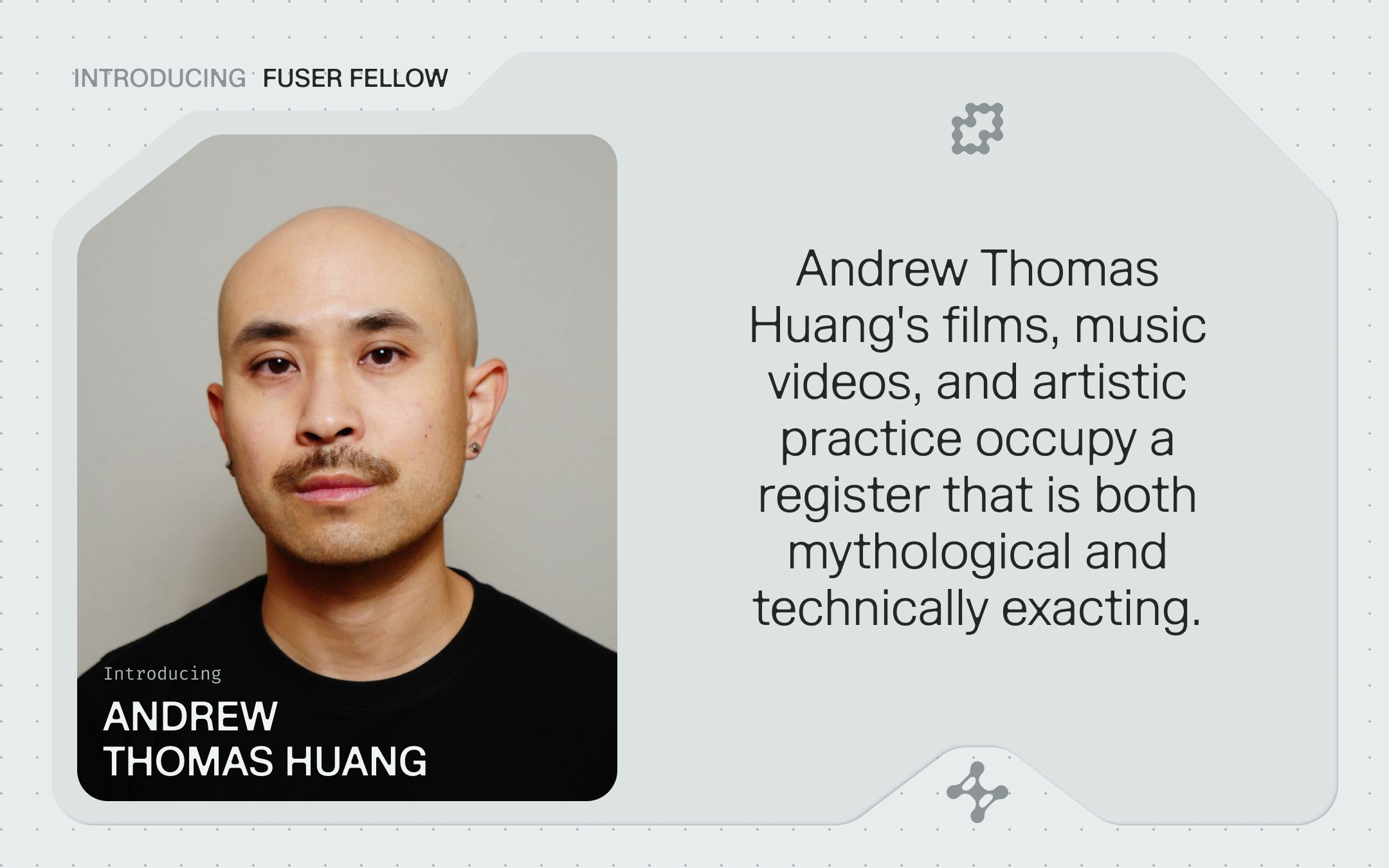
Andrew Thomas Huang is a visionary artist whose work refuses easy categorization. His films, music videos, and artistic practice occupy a register that is both mythological and technically exacting. He has created wholly new, surreal worlds with the precision of someone who has spent decades understanding exactly how their craft generates new meaning. His collaborations with Björk, FKA twigs, and Thom Yorke are among the most formally ambitious music videos produced in the last fifteen years, and his fine art practice has extended those explorations into installation, performance, and now interactive work. For Rhizome’s 7x7 conference at the New Museum, Huang worked with bio artist and researcher Stephanie Zhang to create a browser-based game in which users feed a living slime mold that doubles as a sci-fi mythological archive—a synthesis of deep research, material curiosity, and narrative invention.
We are excited to introduce Andrew Thomas Huang as our very first Fuser Fellow. Over last few months, Fuser has continued to support the development and pre-visualization work for a number of Huang’s upcoming projects. The fellowship reflects a conviction that has guided us from the very beginning: the most interesting things happen when you build tools in proximity to practitioners who will push them past their intended limits.
The conversation below was conducted by writer and curator Ruby Justice Thelot at the New Museum, during the preparation period for Rhizome’s 7x7 conference.
Read on to learn about embodied cognition, distributed intelligence, the wasp-gall logic of creative hacking, and what it actually feels like to work with node-based AI as someone who has spent a career thinking hard about how images are made, and at what cost.
Ruby: Hi. Thanks so much for being here and taking time out of your very busy schedule to speak to me. First of all, tell me: what are you building for 7x7?
Andrew: I had the pleasure of collaborating with Stephanie Zhang, an artist who works with slime molds and cuttlefish inspired materials through her research at Stanford. She explores 3D bioprinting with slime molds and is also replicating the mechanism through which cuttlefish can camouflage. Stephanie is working with material sciences, using living slime molds and cuttlefish biology as a template for creating. Upon learning about her research, my instinct was that we should collaborate to make something that is also living.
So we decided to create a browser-based sci-fi video game in which users can feed a living slime mold. But the slime mold is also a kind of archive. It tells the story of a Chinese mollusk deity from the future recounting its life.
We basically created a fictional, sci-fi mythological text that lives inside the slime mold, so the slime becomes this dynamic archive text. This idea of treating the slime mold’s body as a generative story map was inspired in part by writers like Italo Calvino and Clarice Lispector, authors who have given voice to the nonhuman and woven story through biological and cosmic structures.
Ruby: I love it. I love that 7x7 is always this place of great synthesis between two amazing practices.
Hearing you talk about these imagined deities makes me think about your work more broadly, because there are all these grand creatures in it. I remember seeing the deer piece a few months ago and feeling fully transported into an almost Miyazaki-like state of wonder. Those creatures now kind of live in my own mythology. I think of them as part of my own pantheon.
So it’s always beautiful to see recurring themes in the work. In this specific scenario, is there a particular character? Is there something the deity does?
Andrew: We did research and found that there’s this ancient Chinese deity who behaved a bit like the cuttlefish. The commonality is that these living things like slime molds and cuttlefish have what we might call distributed intelligence.
I was asking Steph, “How does a cuttlefish know what to change color into in order to blend in? Is there a sensor? Is it purely optical?” And Steph explained that its brain is distributed throughout its body, in a way that is similar to the nuclei spread throughout a slime mold.
I’ve been really interested in this idea of embodied cognition, specifically in other life forms.
To answer your question: the creature doesn’t necessarily do something in a conventional narrative sense. Rather, users uncover its story by feeding it, the same way you feed slime molds. Slime molds feed on oats or simple sugars, and they grow dendritically to find that food source, they expand laterally…
Ruby: Rhizomatically, no pun intended.
Andrew: I’ve been focused a lot on embodied cognition and distributed intelligence. Honestly, thanks to a lot of your writing and texts, even from a few years ago, I’ve been thinking about what AI is doing to our consciousness and our physical bodies, and about the importance of returning to almost medieval-style means of communication: trusting what you can empirically know and see with your own body.
So I’ve been thinking a lot about theater and different embodiments. That brought me back to Steph’s practice of working with creatures whose minds live beyond the brain.
Ruby: That’s incredible. It’s hard for me to think about distributed intelligence or collective intelligence and not ask you questions about artificial intelligence.
In some ways, our nervous system has also been imbued with this collective intelligence, but in the West we are so focused on this one part of sensation: the head. Sometimes when I think about AI, I think we are building an intelligence that is really in the cranium, instead of an intelligence that has other inputs: temperature, intuition, the body.
Andrew: I’ve been taking kung fu classes for the last year and a half, and I learned that, in Chinese thought, the mind is actually located in the heart. Other cultures locate the mind differently, or imagine different minds for different parts of the body. So it feels like a modern and Western framework to locate the mind primarily in the cranium. The intelligence we build is cranium-like instead of heart-like. It’s logos-maxing.
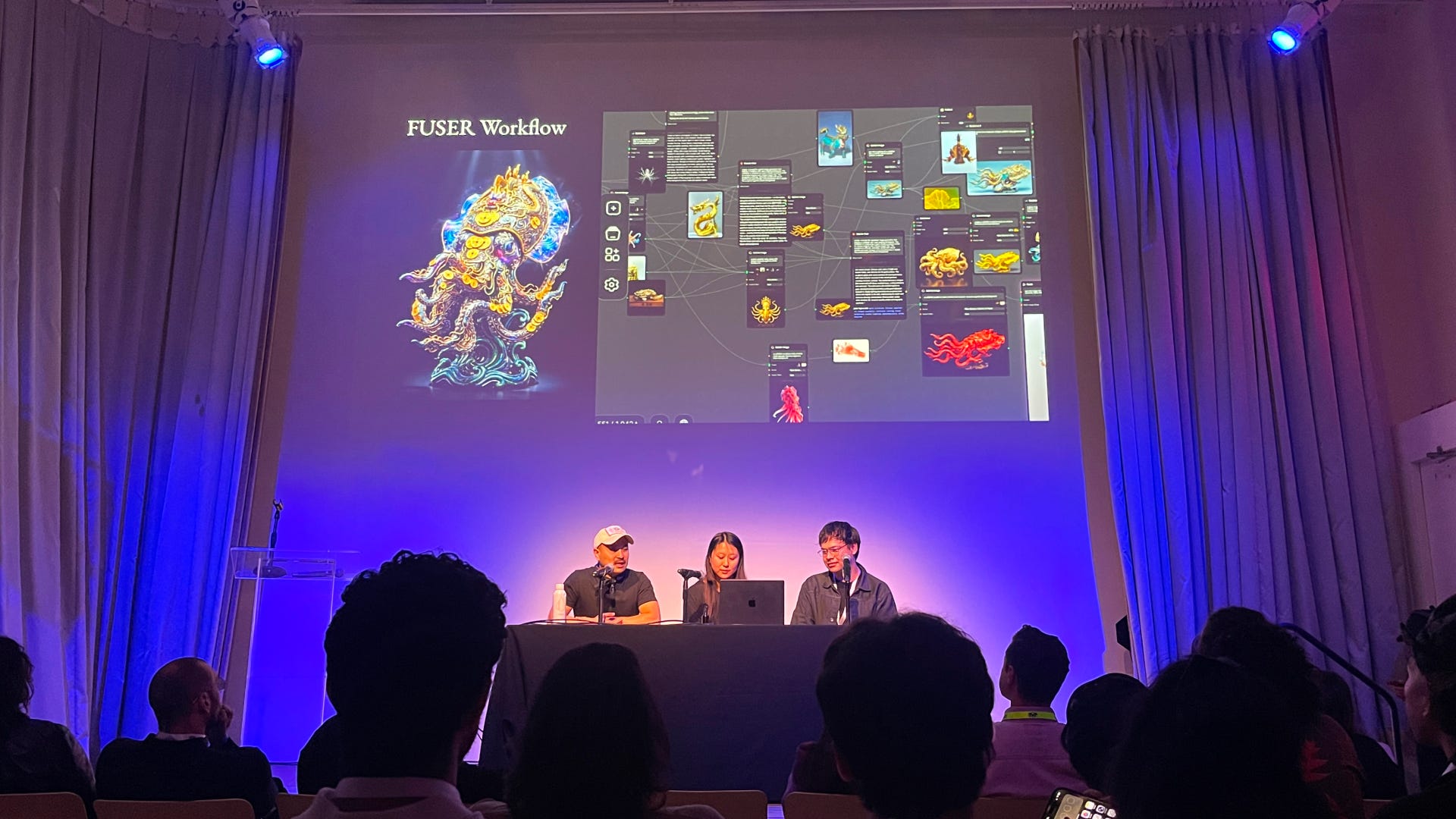
Ruby: You’ve worked a lot with technology throughout your career. I remember seeing the “how it’s made” video for Cellophane and all the rigs involved. One of the sponsors for 7x7 is Fuser, and I know you’ve been spending some time with the platform. How has that experience been?
Andrew: First, I want to say that I was attracted to Fuser because of the people involved. I know Eileen, and Casey Reas was also involved.
Ruby: Legends!
Andrew: Two legends. Hirad, Dalena. I’m attracted not to technology, but to the people and the ideas.
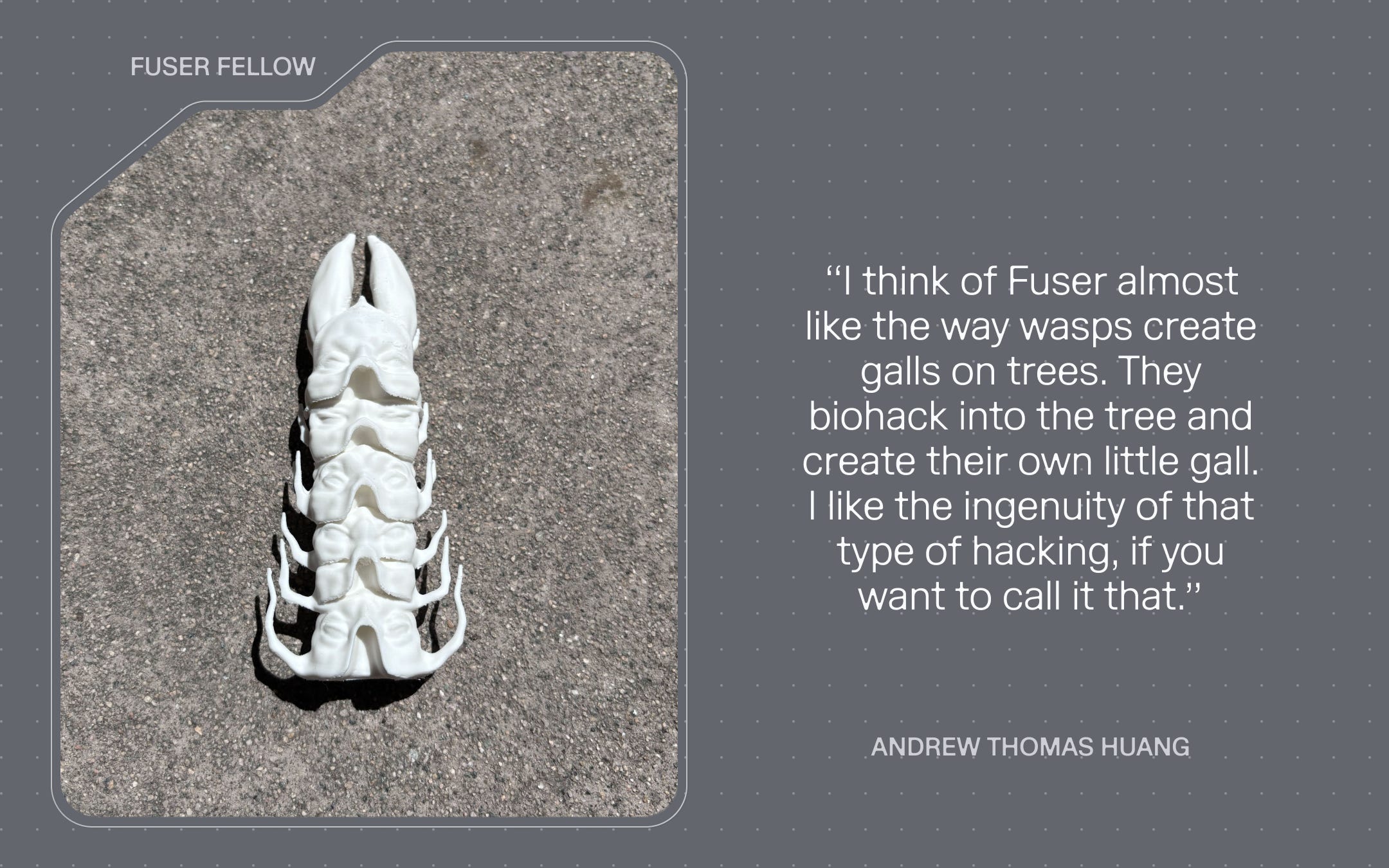
I love that they created this thing that is almost a form of hacking: this aggregator. I think of Fuser almost like the way wasps create galls on trees. They biohack into the tree and create their own little gall. I like the ingenuity of that type of hacking, if you want to call it that.
At the same time, as a creator, flaunting the use of AI in your work still puts you in the crosshairs of a lot of rage bait and anger online. Some of it is justified. We do have to be critical of the large corporate entities pushing this technology, often at our peril.
But artists have never, in history, stopped picking up the scraps and hacking the tools at their disposal in order to create and challenge the system. I’ve spent my entire career button-smashing my way through making. I feel a duty and a responsibility to understand this tool before criticizing it, while criticizing it.
Because of the multitude of tools out there, Fuser makes it really easy to get an eagle’s-eye view.
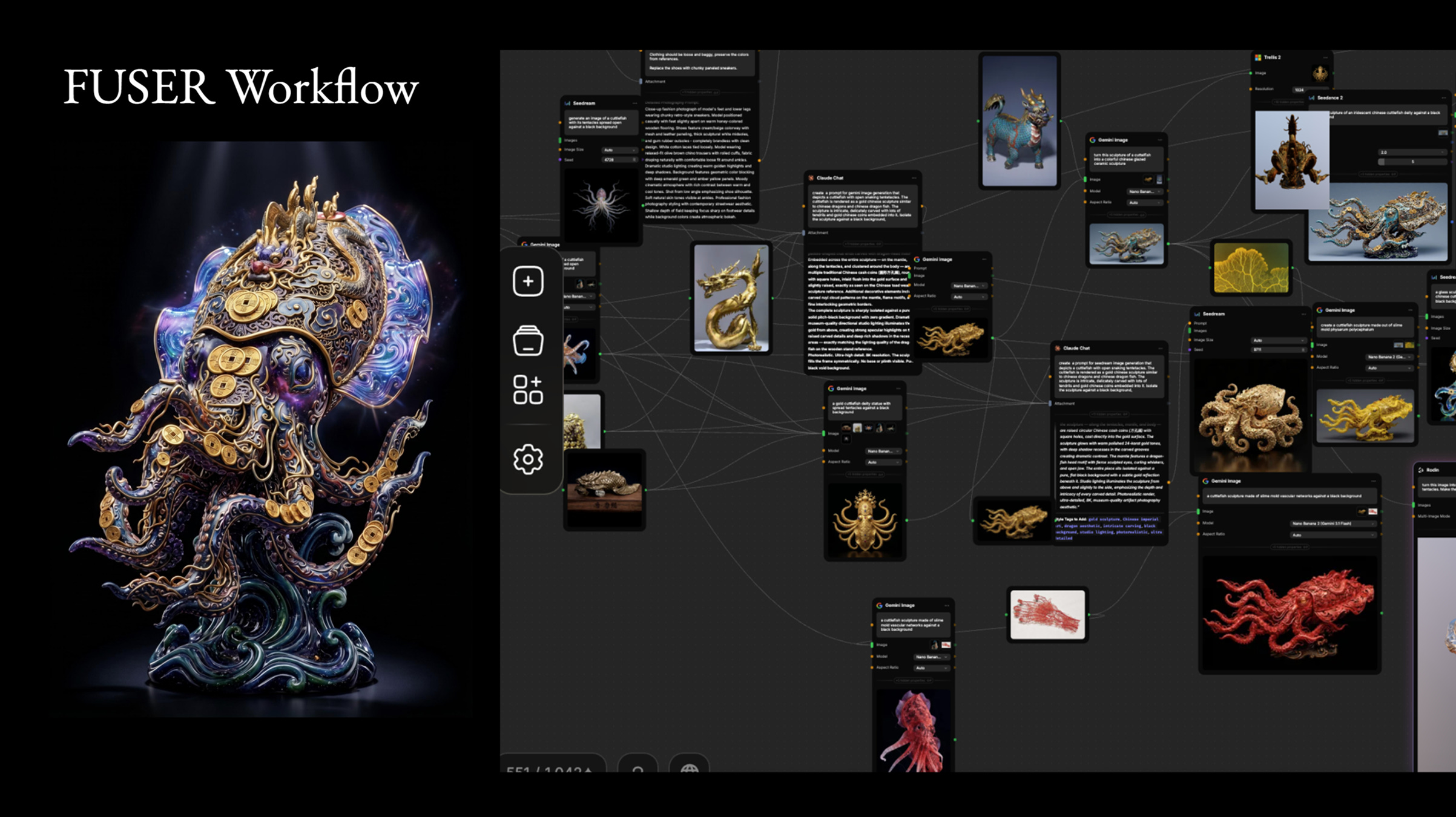
Ruby: A view across all the different models.
Andrew: Exactly. That way of working is pretty amazing. Since I started using Fuser, it has been an incredible companion tool for ideating and conceptualizing work.
But I also keep thinking about your writing and your discourse, because you’re always acknowledging the physicality and sensorial viewer or user experience of what we’re doing. You analyze that critically.
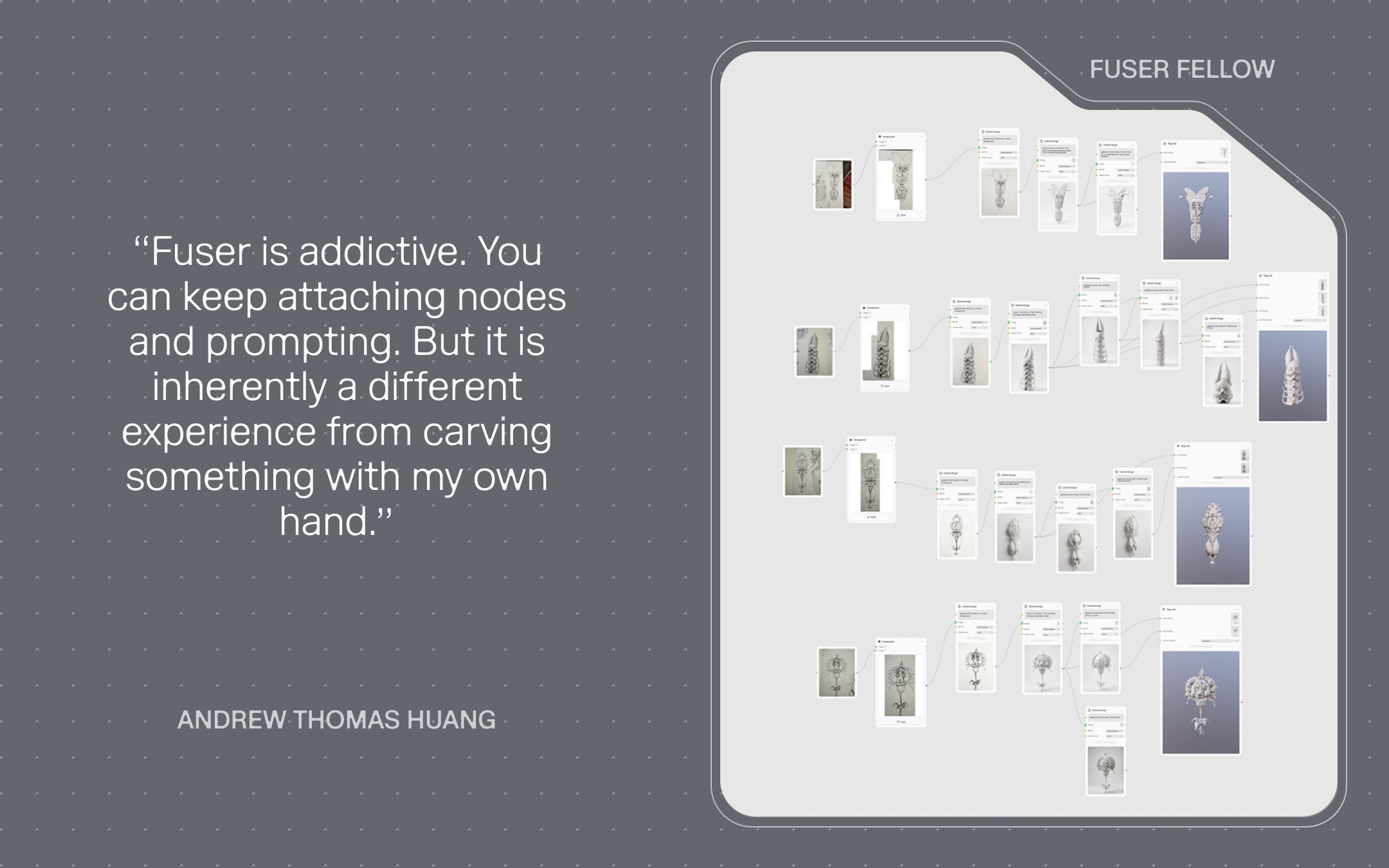
Fuser is addictive. You can keep attaching nodes and prompting. But it is inherently a different experience from carving something with my own hand. They do have tools where you can be quite articulate in arranging images, but I will never stop thinking about what you’ve said about the spawning, the accelerated spawning of images, and the death of images.
Here I am using this apparatus that really is a whole new way of working. I don’t fully know how to describe it.
Ruby: That’s what has been so interesting to me about some of these tools. Even the idea of prompting was strange to me at first. If I want to make an image, I’m going to use words?
Andrew: And now we’re reliant almost entirely on language. We’re logos-maxing the process.
One of the very talented artists who works at Fuser, Maggie Zhu, showed me yesterday how they took an existing image in order to replicate a 1960s vintage celluloid film look. They used Claude to extrapolate, through text, the grain quality and lensing, and created almost like a LUT. They somehow created an automated way to produce a specific node that would give you that look.
But it was all through text. It wasn’t through dialing Kelvin, brightness, or contrast. It was almost like analyzing the pixels and bit depth of the image to extract an essence and then apply it to a new node.
It blew my mind because it really is a different way of working.
Ruby: A totally different way of working.
Andrew: I also can’t help but think of conceptual art. I remember learning about conceptual art for the first time and thinking, I guess reducing art to text has been done before.
I think it falls on all of us, as creators, to decide when and how we want to create on a sensorial level versus a thought-based analytical level. It almost forces us to examine ourselves and the physicality of what we do, and to decide for ourselves what the best medium is.
There are instances in which this Fuser workflow, or this node-based workflow, can be novel, cool, and useful for a specific application. But I am never going to want to give up the plasticity of actually using my hand.
Ruby: I think it behooves us to engage at a high level and to be critical as we’re doing it. We should speak about these novel processes not as replacements, but as new things.
Andrew: Yeah. It’s just new. I can’t compare. It’s almost like the difference between Nuke and After Effects.
I had the pleasure of working with an artist named Matt Zien, who has been making really impressive AI videos for a while. He described the iterative process of working with AI as almost like dripping ink into water and watching the way it swirls. It’s like playing with simulation.
There is this modular process, almost like working with modular synthesizers. You let the pattern ripple out. You’re setting up the conditions for the pattern.
Ruby: You choose viscosity. You choose speed.
Andrew: Exactly. Or it’s like dripping dyes and seeing what happens in the swirl. That is the best comparison I can make: the beautiful unpredictability of it.
Andrew Thomas Huang’s exhibition, The Deer of Nine Colors, is on view at LACMA through June 14, 2026. If you are interested in learning more about our Fuser Fellowship program, please reach out: hello@fuser.studio