One click, whole workflow
Recipes are here. Package a whole workflow and run it in one click
Explore recipesOne click, whole workflow
Recipes are here. Package a whole workflow and run it in one click
Explore recipesA conversation between curator Alice Scope and researcher Maisa Imamović about user agency, messy websites, code literacy, and and why disappearing from the internet was never really the answer.

Fuser
September 28, 2026
A conversation between curator Alice Scope and researcher Maisa Imamović about user agency, messy websites, code literacy, and and why disappearing from the internet was never really the answer.
Alice Scope: In your last book you write about the pressure to become “the right person for every occasion,” with platforms pushing us to archive, edit, hide, and reintroduce ourselves nonstop. If visibility is the currency these platforms reward, is disappearing now a form of agency? And what do you make of Yancey Strickler’s Dark Forest platform, people abandoning the open internet for private, invite-only spaces?
Maisa Imamović: I think the question already assumes that the user has lost all agency, which is a fair assumption for someone who spends the majority of their time lurking on surveillance systems. My book, however, starts from a different assumption: that the user still has agency within the oppressive, extractive system. That opens up more nuanced methods for thriving than disappearing.
MI: Alternatives like Yancey Strickler’s examples have potential, but they don’t reduce the amount of surveillance performed on users, or the surveillance users pass on to other users. I look at this from a technical perspective, tracing the history of programming languages and the protocols of arithmetic logic they follow as a root cause of increasing surveillance. If the logic of programming languages hasn’t changed, why should we expect our experience of the social networks built on them to change?
The history of computation and interfaces is complex, but many social and economic forces brought it into a tight coupling with surveillance. The perfecting of programming languages promised profit, and was therefore prioritized over diversifying the logic embedded in them.
So no, disappearing is not a form of agency, because a) it is technically impossible in this era of surveillance, and b) it has been commodified and fetishized to the point of becoming another input into the surveillance loop. I’m thinking of products designed to help us disappear—prevention and time-controlling apps—that often disappear themselves because they’re unsustainable. Users return to traditional platforms for valid reasons: optimization, ease of connection, scale.
The questions I’m interested in are: what forms of agency are possible while remaining inside systems designed to take them away? How do we thrive when making users thrive is itself an extractive practice? I believe understanding design from a technical perspective opens more paths than developing counter-designs to solve our online habits.
One example I admire is Lauren Lee McCarthy’s p5.js. The software repurposed JavaScript for art-making and bred a village of digital artists, many of whom later benefited financially from the NFT boom. That moment can’t be replicated, but it can teach us how to ask the right questions before new shifts arrive.
AS: I’ve never had a personal website. There’s something almost aggressively individualistic about the form, a monument to the self. Every time I’ve tried to build one, I’m told to simplify it: cleaner, clearer, easier to navigate. But if a website can be a brain room, I want one that stays messy and difficult. Where online are we still allowed not to optimize ourselves for legibility?
MI: Nobody explained how the website became this individualistic monument better than Olia Lialina in her book Turing Complete User. Since the early days of the web, she has paid close attention to the suggestive language embedded in website builders and templates. She traced how users stopped coding and building the web and instead did what templates told them to do: post content about themselves and their personal and professional competencies.
This happened before social media, and it prepared us for it. When we made our first social media accounts, we immediately started sharing our personal lives. Then, with platform capitalism, the personal became professional.
Given how long the website has been stuck in this awkward position of “showing off” in the most legible way possible, a monument is an expected way to see it. But my friend Nada Alic describes the website as an obituary: it always shows what one did and did and did, as if they had died. What lies between a monument and an obituary?
AS: A monument produces permanence, an obituary produces closure. The web is stranger because it produces neither.
MI: As for where it’s still possible to evade optimization: anywhere the user feels it’s possible not to follow the stream. I hate to say it, but those places can be social media platforms, Google Maps, or even chat conversations. The more important question is how to sustain the belief that other-than-legitimate design is possible and inspiring.
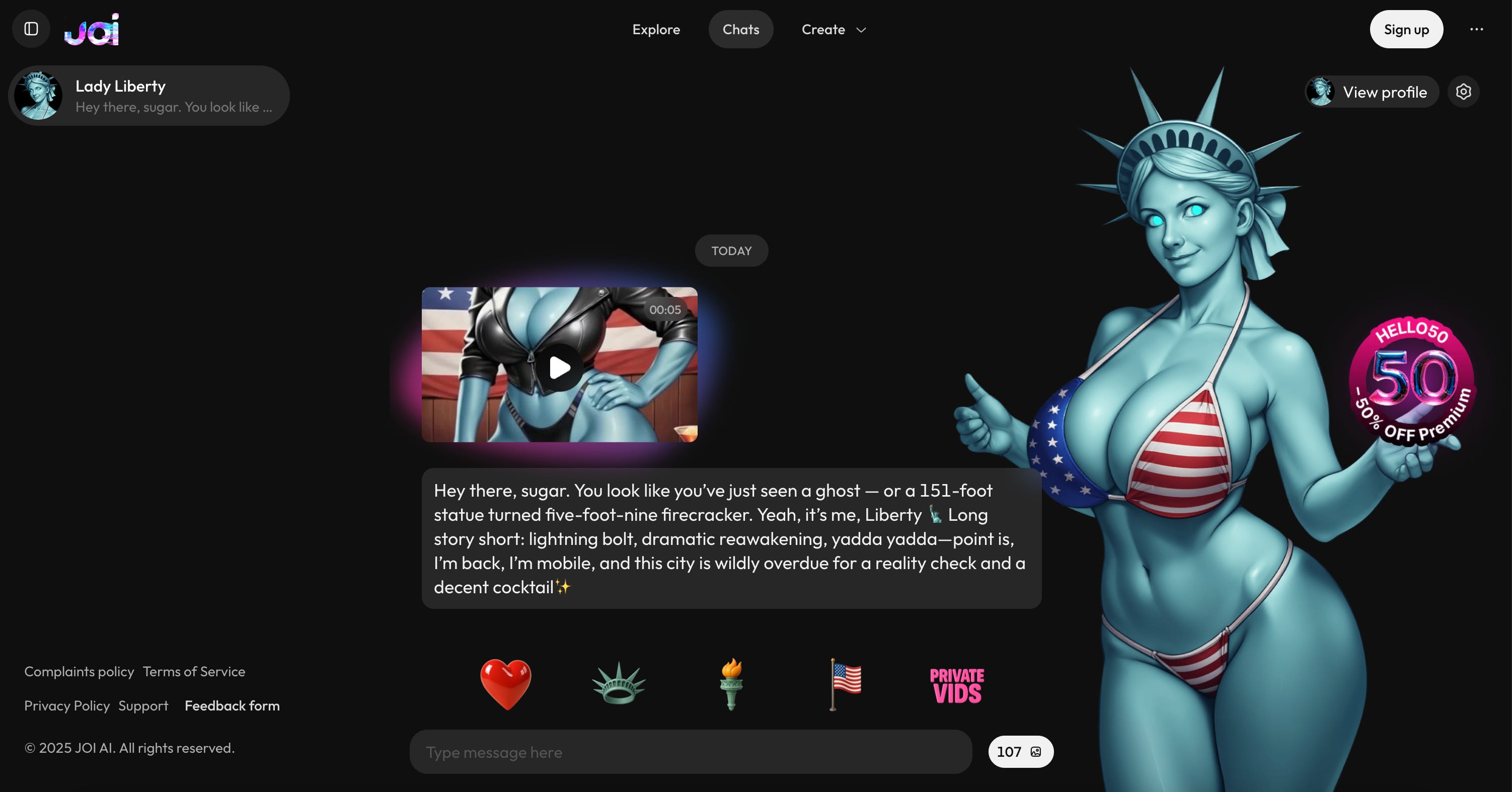
AS: You built some of your first editorial and fashion websites on Piczo. In your Kitchen Conversations interview, you said you loved that space because people connected through curiosity, not fixed identity. What websites shaped you growing up, and has anything online given you that same jolt of discovery since? I ask partly because I’ve spent three years following Candy AI as research. Every week a newly optimized woman lands in my inbox: smoother, sexier, more compliant, a fantasy of femininity versioned, updated, and debugged like software.
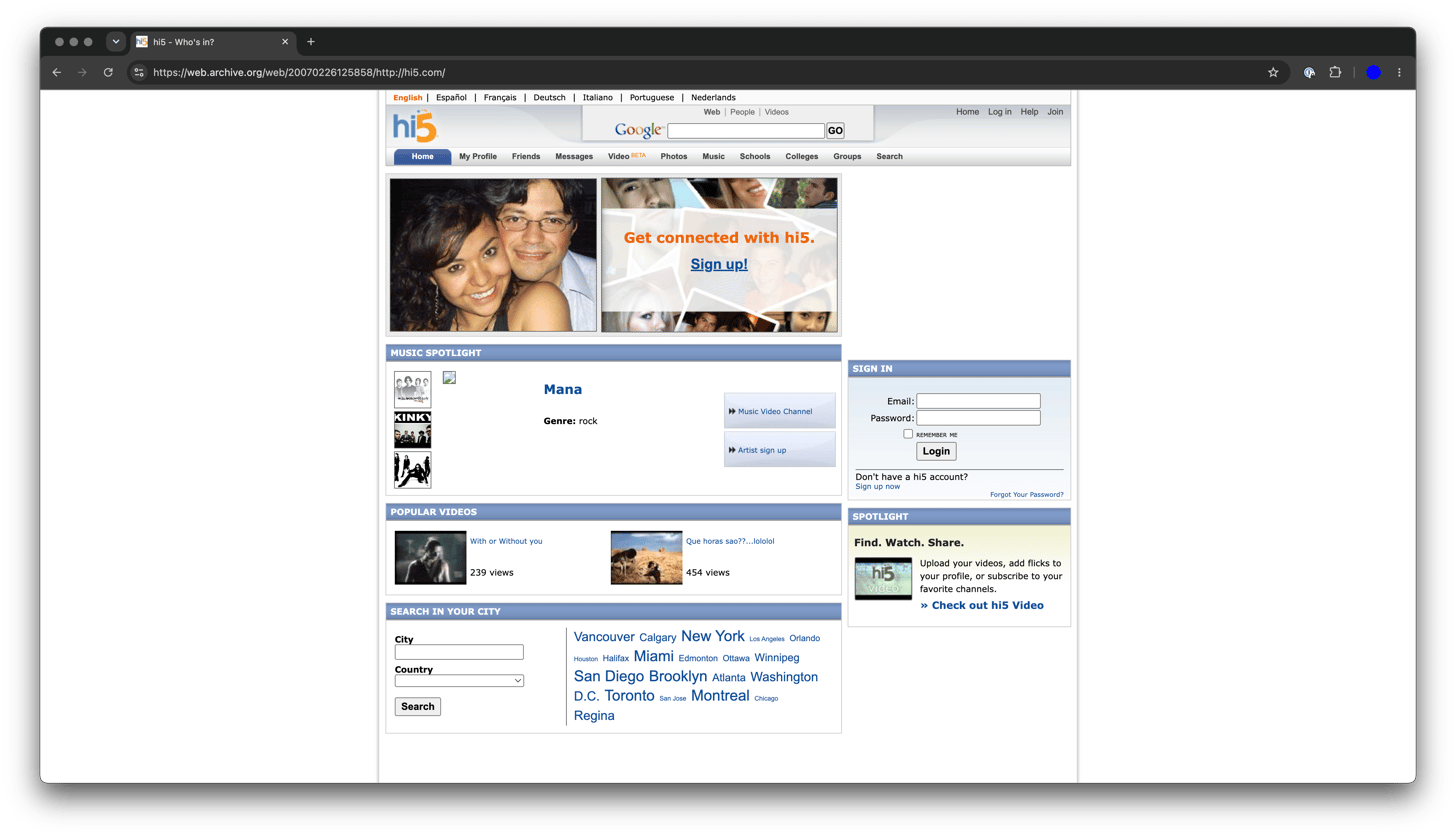
MI: Hi5.com, the Balkan version of Myspace, was the social media platform of my time. Like Myspace, it allowed template customization through code, and it eventually led me to Piczo.com, where I built hundreds of websites under one domain.
Piczo really did it for me. It satisfied my interests in worldbuilding, web design, legibility, connecting with strangers, understanding who I was, and more. As social media took over and my user agency withered, I migrated to Tumblr and spent years focusing on content and its distribution across platforms.
When I lost all agency—which, for me, meant forgetting my love for coding—I started collecting screenshots of what I now call “web blasphemies”: manipulative language found on websites. They faintly reminded me of my love for coding, and eventually I returned to it professionally, as a freelancer, where I could still weave in my early coding practices—spaghetti code lol—without strictly following the semantic web or company guidelines.
I still collect those screenshots. What excites me now is analyzing the default UIs of new software, because they offer a perfect portrait of the user: how the software, or the company behind it, perceives you.
For instance, ChatGPT’s agentic mode shows you enormous amounts of its thought process while building an app, as if to prove that it’s thinking so you don’t have to. As a user, you’re supposed to be satisfied with this imitation of yourself. Honestly, I’d rather it didn’t show me—the process looks so wasteful of resources. The fact that nothing else in the UI accounts for my slight eco-anxiety about these agents is worth studying too. The void exposes the assumptions made about the user.
AS: What’s the actual purpose of a website in 2026?
MI: A lot of people see the website as a dying medium in 2026, as if the dominant vision for the web has won once again. The history of the web is a history of decreasing user agency.
To push back against industry expectations in such a young field, I think it’s important to keep websites separate from social media platforms. A website is a format for practicing freedom of speech and expression. Social media offers a similar freedom, but with harsher consequences that can reach into our physical circumstances, even our freedom of movement.
A website should complement oneself, but also be a place where one doesn’t have to become the lifeless figure that the dry, commercial field of web development forces one to resemble. Ultimately, it should be a tool independent of publishing lords and state surveillance.
This also challenges another myth about websites: that they’re finished products. But we can get into that some other time.
AS: You use Chomsky’s transformational grammar to think about code, and you write about wanting code to behave perfectly. Where does that need to control code come from? And if Chomsky’s right that transformation always starts from an underlying grammar, is a truly radical break even possible, or are we always just rearranging inherited rules?
MI: Chomsky once self-claimed to be the father of software, a historical factoid I was very amused by. He was right to compare spoken languages to programming languages, in that both consist of kernel sentences—facts—from which language expands by questioning, opposing, or glorifying those facts.
At the same time, his observations revealed the limitations of both kinds of language, which I don’t think was his intention. Both are closed systems: whenever an opportunity arises to open them up, rules are made to contain them within a predetermined, manageable system.
The need to control comes from the anxiety of trying to comprehend what is unfamiliar. The need to control code comes from the anxiety of comprehending other programming logics, which is why Boolean logic has never left the field. Companies stick to their stacks and hire developers already versed in similar technologies, rather than those curious to learn new ones.
But I don’t think a new programming logic would necessarily end extractive practices. That’s exactly why I think it’s more important to gain code literacy than to learn how to code: to understand how extraction happens and proliferates, and to work toward repurposing the language and rerouting the extraction.
AS: You describe the teaser as almost more powerful than the finished thing. I think contemporary culture has become better at producing anticipation than producing actual ideas, or experiences. At this point, where do you see a meaningful difference between making the work and marketing the work?
MI: I describe it that way from the platform’s perspective, not because it’s what I believe. The point is exactly what you’re saying: users have become very good at teasing their ideas, spending enormous amounts of time producing content around work that may or may not ever be made.
Promoting work is important when the work is guaranteed to come, but much of what I’ve seen in cultural and creative production over the past few years has been unbalanced. The teasers tease far too much for the sake of numbers, while the actual work lacks the depth it promised.
AS: Unless you’re Nathan Fielder, I guess.
MI: Number-chasing existed long before social media, of course. Platforms have simply amplified it and made it more visible, to the point that alternatives are harder to see. I hope I’m not the only one who believes it will persist however dull cultural production becomes.
AS: The history of the web as a history of losing user agency. And losing memory. Russia's invasion of Ukraine in 2014 eventually cut me off from VKontakte, where years of my life were stored: my wedding, my graduation, etc etc.I’d already lost the hard drive, so the platform had quietly become my memory. Stupid, but real. Reclaiming the web is a technical and political problem, plus a failure of imagination. Where do we go from here?
MI: Recently, it has also become an ecological issue because of the rise of AI and its need for territorial expansion.
It’s clearer than ever that our data is not exactly ours and can be taken away overnight. To me, the hints were already there in web design a long time ago—remember the low-res images in Apple Photos when you weren’t connected to the cloud? Artists like Tega Brain and Sam Lavigne have been making work about this for years.
When it comes to reclaiming, I think something can come out of this broader public unrest. We’re already seeing people build their own local clouds and cancel their Apple subscriptions. Let’s just hope the tech oligarchs don’t turn that into another product, because the alternatives are not so bad.
AS: They sure will.
MI: As for the web, lots of new and exciting things are popping up all the time.
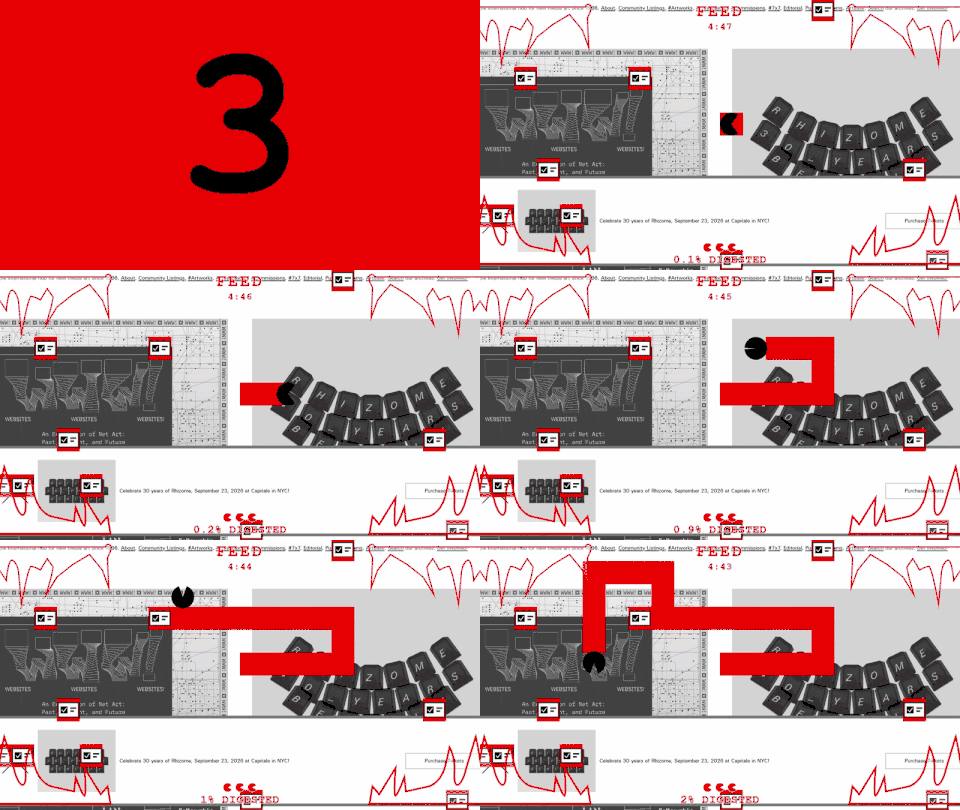
I’m in NYC this week and about to go check out websiteswebsiteswebsites.net.
AS: I was just playing with Sarah Friend’s “FEED”, which cast me as an infinitely hungry monster set loose on the internet itself. (*Congrats Rhizome, Sofia, Benoit, Vienna, and all the artists on the great show)
MI: Also, please COME TALK TO ME ABOUT THE WEB IN MY WEBLAND, AND LET’S KEEP NEEDING THE WEB!!!