One click, whole workflow
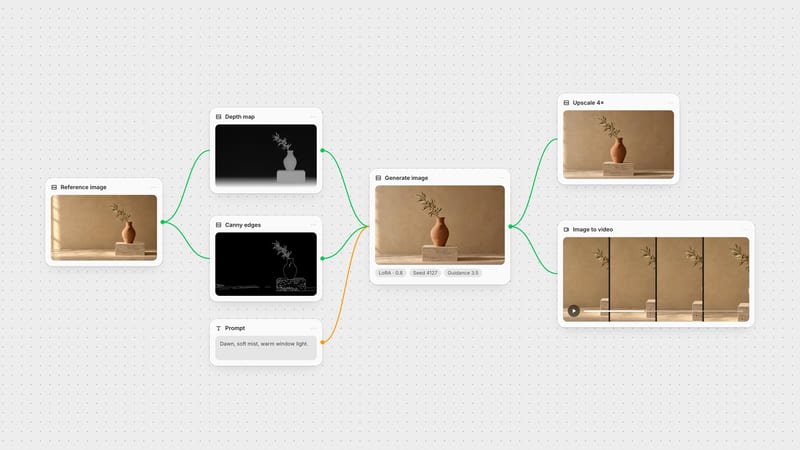
Recipes are here. Package a whole workflow and run it in one click
Explore recipesOne click, whole workflow
Recipes are here. Package a whole workflow and run it in one click
Explore recipesbyByteDance
Extract clean relative depth maps with luminous foreground contours and smooth spatial gradients for ControlNet conditioning

Convert standard 2D photographs into high-contrast relative depth maps in three simple steps to prepare visual assets for structural generative workflows.
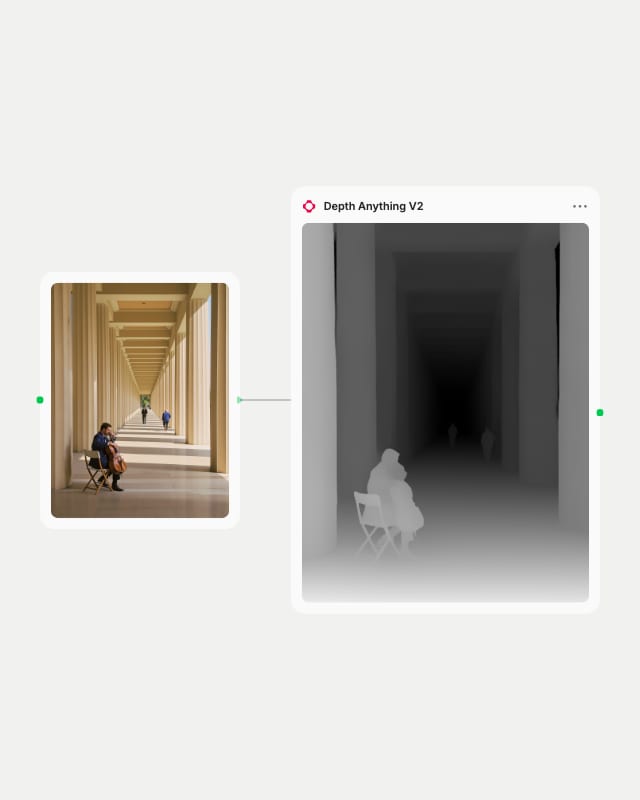
Upload source image
Select a high-resolution photograph with distinct perspective cues and foreground separation.
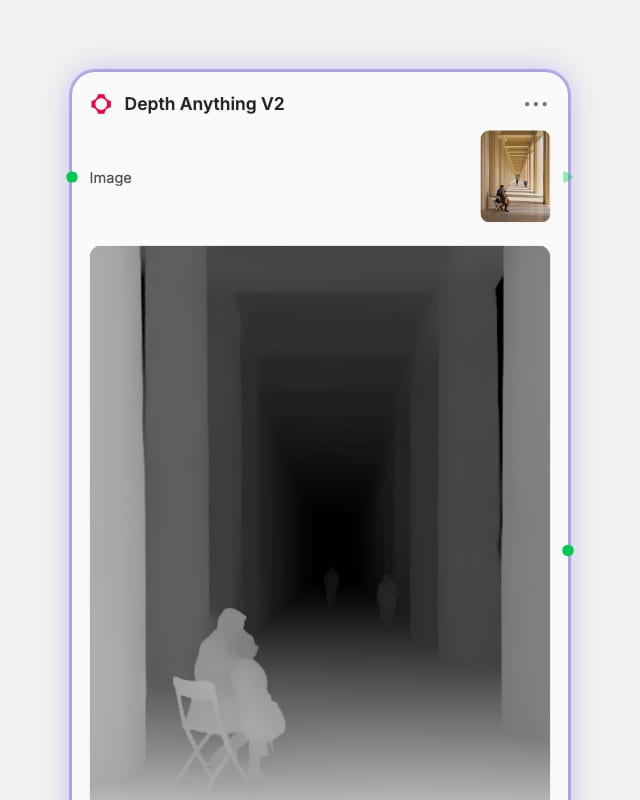
Extract relative depth
Process the image through transformer-based monocular estimation to map spatial proximity.
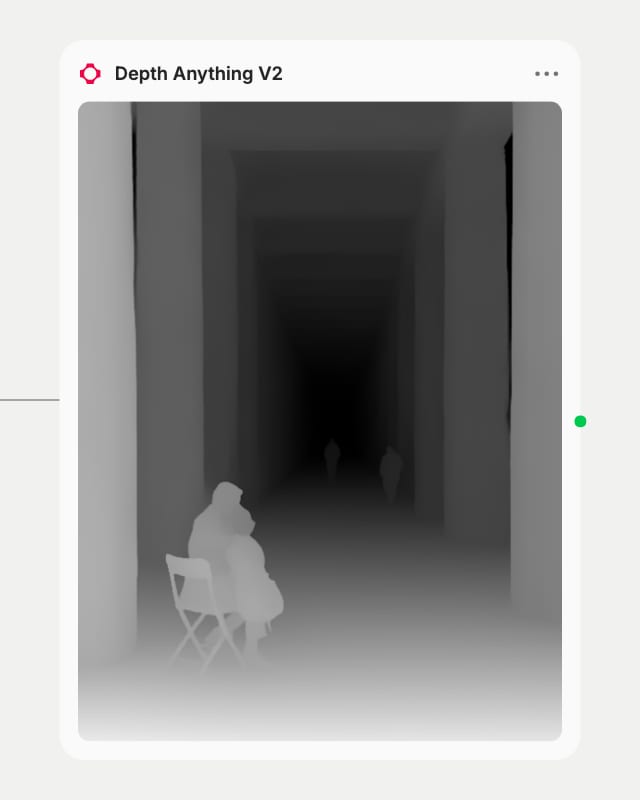
Export for ControlNet
Use the generated grayscale depth map to drive Stable Diffusion workflows or 3D mesh displacement.
Engineered with massive synthetic-to-real distillation, delivering precise edge separation, smooth spatial gradients, and rapid monocular depth estimation.

Sharp Boundary Delineation
Isolates foreground subjects from complex backgrounds with luminous white proximity values and clean silhouette contours, preventing edge bleed in ControlNet passes.

Continuous Spatial Gradients
Maps smooth, progressive depth transitions across complex surfaces, rendering subtle curvature and receding planes without severe stepped banding.

Zero-Shot Geometry Extraction
Estimates reliable relative depth from uncalibrated 2D scenes using synthetic-data pretraining, unlocking instant layout guides for multi-room interiors and facades.

Sub-Second Monocular Inference
Delivers instant depth maps over ten times faster than diffusion-based estimators, keeping real-time Stable Diffusion and generation pipelines frictionless.
Explore grayscale relative depth outputs across varied subjects, highlighting boundary definition and spatial separation from foreground to background.

High-contrast cinematic framing with clear subject-to-void separation

Industrial artisan study with distinct mid-ground planes

Minimalist graphic poster with bold planar depth

E-commerce product still highlighting tactile materials
Discover how creators, VFX artists, and designers integrate relative depth maps into ControlNet conditioning, 3D displacement, and compositing pipelines.
Depth Anything V2 produces substantially sharper object boundaries and cleaner depth gradients by replacing noisy real-world training labels with high-precision synthetic datasets (~595K images) and scaling teacher-student distillation across 62+ million images. This eliminates common spatial distortions and edge bleed.
Depth Anything V2 is optimized for ControlNet depth guidance in Stable Diffusion and SDXL pipelines, 3D mesh displacement mapping from 2D images, and foreground-background separation. Its sub-second execution makes it ideal for real-time generative workflows.
It is over 10x faster and significantly more lightweight than diffusion-based monocular depth estimators such as Marigold. Depth Anything V2 runs in sub-second inference times on single images, making it practical for batch preprocessing and interactive creative workflows.
Depth Anything V2 accepts standard 2D image inputs and outputs a single relative grayscale depth map where luminance represents proximity, with near objects rendered in bright white and distant elements receding into black.
Avoid using Depth Anything V2 for high-precision 3D metrology or robotics requiring exact metric millimeter measurements, as it estimates relative rather than absolute depth. It is also not recommended for raw frame-by-frame video without temporal smoothing, or scenes dominated by ultra-thin rigging, hair, or transparent glass reflections.
Depth Anything V2 was created by researchers at ByteDance and released on June 13, 2024, subsequently presented at NeurIPS 2024.
Extract clean relative depth maps with luminous foreground contours and smooth spatial gradients for ControlNet conditioning