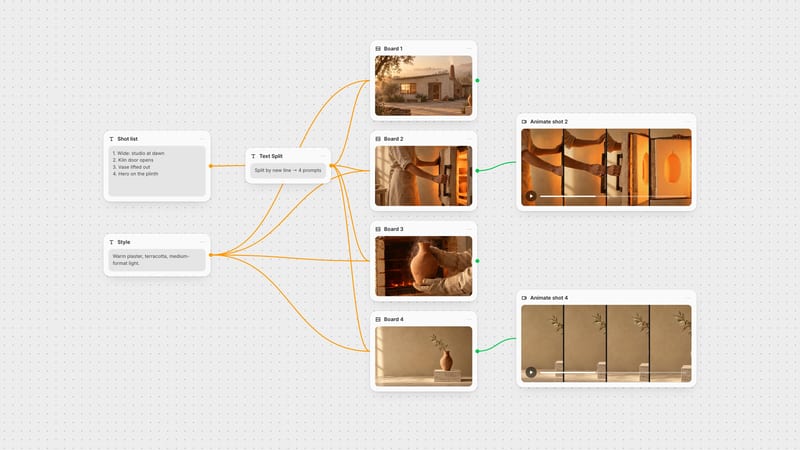
One click, whole workflow
Recipes are here. Package a whole workflow and run it in one click
Explore recipesOne click, whole workflow
Recipes are here. Package a whole workflow and run it in one click
Explore recipesFive tests, one run each, with prompts and images reused from our Kling 4.0 runs: a long take, a character from a photo, a judo throw, start and end frames, and a camera arc ending on a line. What each model did, which won each round and how their costs compare.
All guides · FLUX.3 Video in Fuser · Kling 4.0 in Fuser
Quick answer: FLUX.3 Video in Fuser gave the truer look in our same-prompt test against Kling 4.0, but Kling 4.0 was the more reliable director: it got the physical action, the spoken line and our exact start and end frames right more often. We gave FLUX.3 Video five prompts that Kling 4.0 had already run, with the same text, the same input images and the same length, one run each, on 23 October 2026: a 15-second take with four beats, a character from a start photo, a judo throw, a peony opening between two frames, and a camera arc that ends on a spoken line. Kling 4.0 took the judo throw and the long take on logic and edged the character test; the peony was a tie on the picture; the florist split, with FLUX.3 Video making the fuller camera move and Kling 4.0 the clearer line. In the rounds it lost, FLUX.3 Video still came closer to the written setting: the fog and the red vest, the dojo’s paper windows, the buckets of flowers. Both are nodes in Fuser, two of its 169 video models, so one prompt can go to both and you keep the better take.
No new Kling 4.0 clips were made for this article. Each Kling 4.0 take below is the one from our Kling 4.0 vs Kling 3.0 and Kling 4.0 vs Seedance 2.5 tests, recorded with its exact prompt, inputs and settings. FLUX.3 Video then ran the same requests:
Model: the FLUX.3 Video node with Model set to FLUX.3 Max, which reasons about the prompt before it generates (Reasoning Level High, its default). FLUX.3 Max covers text-to-video, a start frame and a start-and-end pair, every route in this test.
Matched settings: identical prompt text and image files, the same duration, 1080p for rounds 1 to 4 and 720p for round 5, as in the Kling 4.0 runs (FLUX.3 Video returns 1920×1088 and 1280×704 frames at those settings, Kling 4.0 1920×1080 and 1280×720). 16:9 where Kling 4.0 set 16:9; with a start image both follow the image’s shape. FLUX.3 Video’s Generate Audio was on, its default; Kling 4.0 generates sound with every clip.
One take each: one FLUX.3 Video run per round, no retries, no picking between takes.
We looked at every clip frame by frame, ran scene detection for cuts (it found none in any clip), compared first and last frames with the input images, measured each soundtrack and transcribed the spoken line. Each video plays FLUX.3 Video on the left and Kling 4.0 on the right, each cropped to the centre of its frame. Rounds 1 to 4 play without sound; round 5 plays twice, with FLUX.3 Video’s sound first and Kling 4.0’s second.
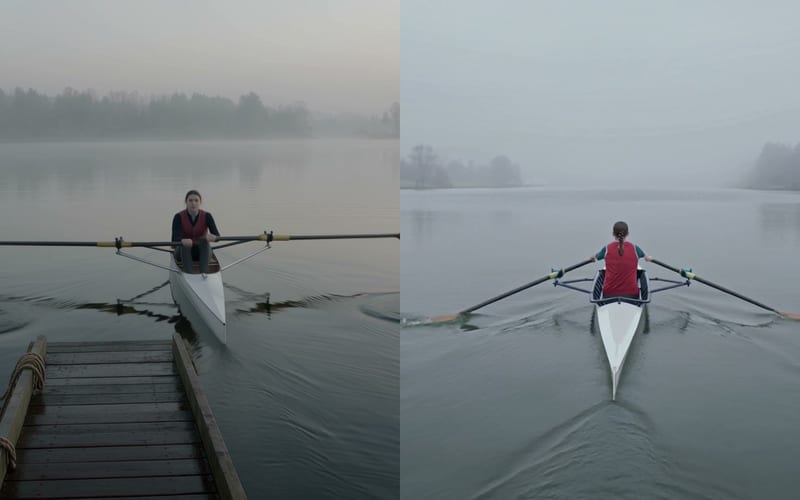
Text-to-video, 15 seconds, 16:9, 1080p. Prompt: “One unbroken handheld take on 16mm film, misty grey dawn, a muted palette of wet timber, slate water and fog with one faded-red accent. 0-4s: inside an old timber boathouse on a still lake, a young woman in a faded red rowing vest and grey leggings lifts a pair of long wooden oars down from a wall rack. 4-8s: she carries the oars on her shoulder down the wet wooden slipway, the camera following behind her at shoulder height. 8-12s: she steps carefully into a narrow white single scull tied at the jetty, sits, and slots the oars into their riggers. 12-15s: she pushes off from the jetty with one hand and takes her first stroke, the scull gliding out into the fog, ripples spreading toward the camera. Sound: creaking boards, her footsteps, water lapping, one distant bird call.”
Both held one continuous take for all 15 seconds and reached each beat near its timestamp.
FLUX.3 Video got the opening exactly: a boathouse wall lined with oars, the rower lifting them off the rack and carrying two of them, the pair we asked for, out to the water, the camera following behind her. Slate water, fog and wet timber, with the faded-red vest as the only colour.
Then the props stopped adding up. The scull at the jetty already had its oars rigged, so one of hers was left standing upright on the jetty, and she never slotted the ones she carried. She sat facing the bow and rowed off the way she faced, which is backwards for a rowing shell.
Kling 4.0 carried a single oar on her shoulder but kept the logic: she sat, fitted the oars and rowed away facing the camera, the way rowers sit. Its picture was darker and cooler than the misty grey dawn we wrote.
Sound: FLUX.3 Video’s track was sparse, about 16 dB quieter on average than Kling 4.0’s.
Verdict: Kling 4.0 on the logic of the scene; FLUX.3 Video on the look and the first two beats.
Image-to-video, 8 seconds, 1080p, with one bookshop portrait as the start frame. Prompt: “He takes off his round tortoiseshell glasses and wipes the lenses on his rust sweater, then turns away to the shelf on the right and pulls out a faded green book. He turns back to the camera, puts the glasses back on, opens the book and looks up with a broad smile. The camera holds a steady medium shot with a slight drift. Sound: quiet shop room tone, the book sliding from the shelf, pages turning.”
Both kept him. Through 8 seconds and a turn to the shelf, each held the square white beard, the flat cap, the rust cable-knit sweater, the round tortoiseshell frames and the small mole on his cheek, and each ended on a face that matched the photo.
FLUX.3 Video did the wipe properly, rubbing the lenses on his sweater, and kept the glasses in his hand while he reached for the shelf. Two details slipped: the book came out with a dark cover rather than a faded green one, and he opened it a beat before putting his glasses back on.
Kling 4.0 played every step in order, with a green book, and put the glasses on before opening it.
Its first frame was our photo almost to the pixel. FLUX.3 Video’s opening frame was a close redraw of it: the same composition, a touch more contrast.
Verdict: Kling 4.0, narrowly. Identity was a tie.
Text-to-video, 5 seconds, 16:9, 1080p. Prompt: “Real-time speed, 35mm documentary look, flat daylight from tall paper windows in an old wooden dojo with straw-yellow tatami. Two women judoka, one in a white judogi and one in a deep blue judogi, grip each other's lapels and sleeves. The woman in white steps in, turns her hip under her opponent and throws her in a clean hip throw; the woman in blue rotates over her hip through the air, lands flat on her back with a loud slap of the mat and immediately rolls up to her knees. Camera: low handheld, side-on, following the throw. Sound: bare feet on tatami, a sharp exhale, the slap of the landing.”
FLUX.3 Video built the room we wrote: tall paper windows, straw-yellow tatami with dark borders, a dark wooden hall. Kling 4.0 gave glazed windows and smooth competition mats.
The throw stalled in FLUX.3 Video. The woman in white loaded her opponent onto her hip, the woman in blue slid back down to her feet, and the throw started again before she went over. She landed on her side rather than flat on her back, then got up to her knees as asked. The loudest sound in the clip came with the fall, at about 3.5 seconds.
Kling 4.0 threw in one clean motion: over the hip, flat on her back, the thrower still on her feet.
Neither gave us the low handheld follow; both kept a mostly steady side-on frame.
Verdict: Kling 4.0. Fast contact between two people was FLUX.3 Video’s weakest round.
Image-to-video, 5 seconds, 1080p, with a bud as the first frame and the open bloom as the last. Prompt: “Locked-off camera with a very slow push-in. Time-lapse over one day: the coral peony bud loosens and opens petal by petal into a full, heavy bloom, its head dipping on the stem; two petals drop and land on the oak table; the sunlight and the shadow on the plaster wall slide slowly to the right. Sound: quiet room tone, a soft tap as the petals land.”
Both opened the bud petal by petal, let two petals fall and settle where our end frame has them, and finished on the end composition. Side by side they are hard to tell apart.
Kling 4.0 had its first petal falling by 2.7 seconds; FLUX.3 Video had one on the table by 3 seconds.
The difference is in the frames themselves. Kling 4.0 started and ended on our two images almost exactly (a structural similarity of 0.99 and 0.97 at preview size). FLUX.3 Video redrew them, a fraction tighter and with more contrast and colour (0.59 and 0.60). You see it only if you lay its frame over the source.
Sound: neither stayed with quiet room tone. FLUX.3 Video’s track was quiet with one blip at about 4 seconds, not on the petals; Kling 4.0’s was much fuller.
Verdict: a tie on the shot. If the clip has to cut cleanly into the exact frames you supplied, Kling 4.0.
Text-to-video, 5 seconds, 16:9, 720p. Prompt: “Single continuous camera move, no cuts. The shot opens wide on a young florist with curly black hair and a mustard canvas apron, standing among galvanised buckets of coral ranunculus and white anemones under the iron-and-glass roof of an empty covered market at first light. The camera arcs a slow half circle around him, from behind his left shoulder round to face him, while pushing in, and ends in a close-up as he looks up from the stems in his hands and says: "First ones in today." Cool blue daylight from the high windows, one warm bulb above the stall. Sound: the rustle of paper and stems, a distant shutter rolling up, his line spoken clearly.”
FLUX.3 Video made the whole move: from behind his shoulder, round past the coral ranunculus and white anemones, pushing in to a close-up as he looks up, under the iron-and-glass roof with one warm bulb.
The line came too late. His speech starts at about 4.4 seconds of 5, and our transcript caught only “in today” before the clip ended. Black Forest Labs’ audio guide warns that speech may not start right away and suggests a shorter line or a longer clip.
Kling 4.0 also arced round from behind him and ended facing him, on a medium shot rather than a close-up, and spoke the line at 3.9 seconds; the transcript read “First one’s in today.”
Verdict: FLUX.3 Video for the camera move, Kling 4.0 for the line. For dialogue in a 5-second clip, Kling 4.0.
Both models made sound for every clip. FLUX.3 Video’s tracks came back mono and, in rounds 1 to 4, between about 7 and 16 dB quieter on average than Kling 4.0’s stereo mixes; in round 5 the two were level. Where FLUX.3 Video placed a sound, it tended to land on the action: the book leaving the shelf, the judoka hitting the mat. FLUX.3 Video has a Generate Audio switch for a silent clip; Kling 4.0 always generates sound.
FLUX.3 Video (model page): a prompt, a start image, an end image, or a clip to extend; 5 to 20 seconds; Auto, 21:9, 2:1, 16:9, 4:3, 1:1, 3:4 or 9:16; 720p or 1080p. Its Model switch picks FLUX.3, which adds a fast 720p Draft mode and Extend, or FLUX.3 Max, which adds a Reasoning Level and a fixed seed. Black Forest Labs documents dialogue in quotation marks, labelled multi-shot prompts and on-screen text (FLUX.3 Video docs).
Kling 4.0 (model page): a prompt, start and end images, up to 10 reference images and 5 reference clips cited as @Image1 and @Video1; 3 to 30 seconds; 16:9, 9:16, 1:1, 21:9 or Auto; 720p or 1080p; and an Edit mode that changes an existing clip while keeping its motion. Sound is always on (Kling 4.0 user guide).
So only FLUX.3 Video continues a clip you already like, drafts cheaply, offers 2:1, 4:3 and 3:4, and can stay silent; only Kling 4.0 runs past 20 seconds, takes reference images and clips, and edits footage.
Both nodes charge by the second of output. At the credit prices Fuser charges, a 1080p second of FLUX.3 Video costs about a quarter more than a 1080p second of Kling 4.0, and a 720p second slightly more. FLUX.3 and FLUX.3 Max cost the same. FLUX.3’s Draft mode costs a little under two-fifths of a Kling 4.0 720p second, the cheapest way to try a shot on either; extending a clip is its priciest mode, close to twice its normal 1080p rate. Our five FLUX.3 Video clips cost about a fifth more than the five Kling 4.0 clips. Each node shows its cost before it runs (Fuser docs).
Use Kling 4.0 when the action has to read correctly, such as a throw, a sport or objects handled in order; when a line has to land inside a short clip; when the clip must start and end on your exact frames; or when you need more than 20 seconds, reference images or clips, or an edit of existing footage. Its prompt guide covers timed beats and @references.
Use FLUX.3 Video when the look is the point: the setting, light and palette we wrote came through closer in every round. It is also the one for cheap drafts, for continuing a clip, for 2:1, 4:3 or 3:4 framing, and for silent plates. See the FLUX.3 Video prompt guide for how we wrote these prompts and what to change when a take slips.
A practical split: explore looks and draft on FLUX.3 Video, then render action-heavy or dialogue shots on Kling 4.0, side by side on one canvas.
Put your prompt in a Text node and wire it, with any start and end images, into a FLUX.3 Video node and a Kling 4.0 node on the same canvas. Run both, keep the better take, and send it on to an edit or an upscale without leaving the board.
One FLUX.3 Video run per round against the recorded Kling 4.0 take, 23 October 2026.
| Round | FLUX.3 Video | Kling 4.0 |
|---|---|---|
| Results | ||
| 15 s take, four beats (16:9, 1080p) | Truest look and opening beats; scull already rigged, rowed facing the bow. | Winner on logic. Fitted the oars and rowed the right way round. |
| Character from a start photo (8 s, 1080p) | Same man; wiped the glasses, but a dark book and one step out of order. | Winner, narrowly. Every step in order, green book. |
| Judo hip throw (5 s, 1080p) | Right dojo and paper windows; the throw stalled and restarted. | Winner. One clean throw, flat on her back. |
| Start and end frames (5 s, 1080p) | Tie on screen; redrew both frames with more contrast. | Tie on screen; matched both frames almost exactly. |
| Camera arc, spoken line (5 s, 720p) | Winner on camera: full arc into a close-up. Line too late, clipped. | Arc ending on a medium shot; line clear at 3.9 s. |
| Cost per second in Fuser | About a quarter more at 1080p; Draft mode far cheaper. | The cheaper of the two at 720p and 1080p. |
In our five same-prompt rounds, Kling 4.0 was more reliable on action, spoken lines and exact start and end frames, and FLUX.3 Video came closer to the written look, light and setting, and made the fuller camera move. Each round was one run per model, and both run as nodes in Fuser.
Kling 4.0 per finished second: at 1080p a second of FLUX.3 Video costs about a quarter more, and at 720p slightly more. FLUX.3 Video’s 720p Draft mode is cheaper than either.
Not as separate references. The FLUX.3 Video node takes a start image, an end image or a clip to extend. Kling 4.0 takes up to 10 reference images and 5 reference clips that you cite in the prompt.
In Fuser, FLUX.3 Video runs 5 to 20 seconds and Kling 4.0 runs 3 to 30 seconds in one pass. FLUX.3 Video can also extend an existing clip.
Yes. FLUX.3 Video has a Generate Audio switch that is on by default; Kling 4.0 always generates sound. In our runs FLUX.3 Video’s tracks were mono and quieter, and Kling 4.0’s were louder stereo mixes.
Yes. In Fuser, connect one Text node and any start and end images to a FLUX.3 Video node and a Kling 4.0 node on the same canvas, run both and keep the better take.
One prompt into FLUX.3 Video and Kling 4.0, side by side on one canvas, from a cheap draft to the 1080p keeper.