One click, whole workflow
Recipes are here. Package a whole workflow and run it in one click
Explore recipesOne click, whole workflow
Recipes are here. Package a whole workflow and run it in one click
Explore recipesWe ran Kling 4.0 and Kling 3.0 on the same four prompts and frames: a 15-second take, a character from a photo, a judo throw and a start-to-end transition. What differed, a verdict per round, and cost.
All guides · Kling 4.0 in Fuser · Kling 3.0 Video in Fuser
Quick answer: Kling 4.0 in Fuser is the better choice for long takes, fast physical action and shots with several steps of direction; Kling 3.0 matched it on a start-and-end-frame transition for less. We gave both models the same four prompts and frames on 23 October 2026, one run each: a 15-second single take, a character working from a start photo, a judo throw and a peony opening between two frames. Kling 4.0 won the first three, mostly on following the prompt's logic: it rowed the boat the right way round, kept a pair of glasses where they should be and landed a clean judo throw. On the peony the two were almost indistinguishable. Kling 4.0 also does things the Kling 3.0 node can't: clips up to 30 seconds, reference images cited as @Image1, 21:9 and editing an existing video. Kling 3.0 keeps a negative prompt, CFG scale, the Turbo tiers and an audio-off option. Both are nodes in Fuser, two of its 169 video models, so the same prompt and frames can go to each and you keep the better take.
Kling calls 4.0 a native multimodal model and lists single generations of 3 to 30 seconds, up to 10 reference images and up to 5 reference videos totalling 30 seconds, first and last frames, and two-channel stereo sound (Kling 4.0 user guide). Its feature page says 4.0 extends native generation from 15 to 30 seconds and improves fast motion, physical interactions and camera control (Kling 4.0 feature page). Kling 3.0 runs 3 to 15 seconds, with or without native audio, in 720p or 1080p modes (Kling VIDEO 3.0 guide). Kling also lists 4K and 10-bit HDR for 4.0 as coming soon; Fuser offers 720p and 1080p today.
In Fuser, the two nodes differ like this:
Kling 4.0 (model page): prompt, start image, end image, up to 10 reference images and up to 5 reference videos, cited as @Image1 and @Video1; 3 to 30 seconds; 16:9, 9:16, 1:1, 21:9 or Auto; 720p or 1080p. A Mode switch turns the same node into a video editor that restyles a source clip and keeps its motion and length. Sound is always on: Kling says audio-visual sync has no separate toggle.
Kling 3.0 Video (model page): prompt, start image, end image, negative prompt and CFG scale; Standard, Pro, Turbo Standard and Turbo Pro; 3 to 15 seconds; 16:9, 9:16 or 1:1; a Generate Audio toggle that is off by default. No reference-image input.
Each prompt went to both nodes with identical text, frames and duration, with the requests built the way each node builds them. Kling 4.0 ran at 1080p. Kling 3.0 ran at Pro, its 1080p tier, with Generate Audio switched on to match Kling 4.0, which always makes sound, and its other controls at their defaults. Every clip below is the only run of that test; none was retried.
Round 1, a long take: text-to-video, 15 seconds (Kling 3.0's maximum), 16:9. Four timed beats of a rower leaving a boathouse in fog.
Round 2, a character from a photo: image-to-video, 8 seconds, with one bookshop portrait as the start frame. A start frame is the only image input the Kling 3.0 node has, so it is how both models got the same picture of the man.
Round 3, fast action: text-to-video, 5 seconds, 16:9. Two judoka and a hip throw.
Round 4, start and end frames: image-to-video, 5 seconds, with the same first frame of a peony bud and last frame of the open bloom.
We looked at every clip frame by frame, compared each clip's first and last frames with our inputs, and measured each soundtrack's level. The full prompts are below each round. Each round plays both clips side by side, Kling 4.0 on the left and Kling 3.0 on the right, without sound. The picture of the man and the two peony frames were made with an image model before the test.
Prompt: "One unbroken handheld take on 16mm film, misty grey dawn, a muted palette of wet timber, slate water and fog with one faded-red accent. 0-4s: inside an old timber boathouse on a still lake, a young woman in a faded red rowing vest and grey leggings lifts a pair of long wooden oars down from a wall rack. 4-8s: she carries the oars on her shoulder down the wet wooden slipway, the camera following behind her at shoulder height. 8-12s: she steps carefully into a narrow white single scull tied at the jetty, sits, and slots the oars into their riggers. 12-15s: she pushes off from the jetty with one hand and takes her first stroke, the scull gliding out into the fog, ripples spreading toward the camera. Sound: creaking boards, her footsteps, water lapping, one distant bird call."
Both kept one continuous take for all 15 seconds, with no cut, and hit every beat roughly on its timestamp. Each carried a single oar rather than the pair we asked for.
Kling 4.0 followed the steps. The boathouse wall holds a rack of oars, the scull waits alongside the jetty, and she sits and fits the oars before pushing off. She then rows facing the camera while the boat moves away, which is how a rower sits.
Kling 3.0 lost the thread at the boat. The scull at the end of the jetty already had its oars rigged, so she stood in it still holding a third oar, which then disappeared. She rowed away facing the bow, the way the boat was travelling, which is backwards for a rowing shell.
Look: Kling 3.0 gave the softer, mistier picture with greener trees; Kling 4.0 went darker and cooler, with a faint pink dawn sky.
Sound: Kling 4.0's track had footsteps in time with her walk, then water once she rowed, about 22 dB louder on average than Kling 3.0's, which was close to silent.
Verdict: Kling 4.0. Both stayed in one take; only Kling 4.0 kept the actions in a sensible order.
Prompt, with the portrait as the start frame: "He takes off his round tortoiseshell glasses and wipes the lenses on his rust sweater, then turns away to the shelf on the right and pulls out a faded green book. He turns back to the camera, puts the glasses back on, opens the book and looks up with a broad smile. The camera holds a steady medium shot with a slight drift. Sound: quiet shop room tone, the book sliding from the shelf, pages turning."
Identity held in both. Across 8 seconds and a turn to profile, each kept the square white beard, the flat cap, the rust cable-knit sweater, the round tortoiseshell frames and the small mole on his cheek. His face at the end matched the photo in both clips.
Kling 4.0 kept the glasses where they belonged. He took them off, held them while he turned to the shelf and pulled out a green book, then put them back on before opening it.
Kling 3.0 duplicated them. He took the glasses off, but by the time he reached the shelf they were back on his face, and a few seconds later he was wearing a pair and holding a second, ghostly pair in his hand.
Verdict: a tie on the face, a clear win for Kling 4.0 on the action.
Prompt: "Real-time speed, 35mm documentary look, flat daylight from tall paper windows in an old wooden dojo with straw-yellow tatami. Two women judoka, one in a white judogi and one in a deep blue judogi, grip each other's lapels and sleeves. The woman in white steps in, turns her hip under her opponent and throws her in a clean hip throw; the woman in blue rotates over her hip through the air, lands flat on her back with a loud slap of the mat and immediately rolls up to her knees. Camera: low handheld, side-on, following the throw. Sound: bare feet on tatami, a sharp exhale, the slap of the landing."
Kling 4.0 performed the throw as written. The woman in white loaded her opponent onto her hip and turned her over; the woman in blue landed on her back while the thrower stayed on her feet, then got up onto her hands and knees. The two bodies stayed separate through the fastest frames, and the loudest sound in the clip landed with the fall.
Kling 3.0 turned it into a pile-up. The two judoka locked together, flipped over as one tangle and both hit the mat; in the mid-air frames it is hard to tell whose limbs are whose. The woman in white ended the clip on the floor too.
Neither gave us the low handheld follow we asked for; both kept a mostly steady side-on frame. Kling 4.0 was closer to the setting, with straw-yellow tatami and dark wooden walls; Kling 3.0 gave a plainer hall with pale mats.
Verdict: Kling 4.0, by the widest margin of the test. This is the fast physical interaction Kling says it improved.
Prompt, with a bud as the first frame and the open bloom as the last: "Locked-off camera with a very slow push-in. Time-lapse over one day: the coral peony bud loosens and opens petal by petal into a full, heavy bloom, its head dipping on the stem; two petals drop and land on the oak table; the sunlight and the shadow on the plaster wall slide slowly to the right. Sound: quiet room tone, a soft tap as the petals land."
Both opened the flower convincingly, petal by petal, with its shadow growing on the wall, dropped petals that fell and settled where our end frame has them, and arrived on our last frame.
The timing differed slightly. Kling 4.0 had its first petal falling by 2.7 seconds; Kling 3.0 was fully open by then and let its petals go about a third of a second later.
By a structural-similarity score, Kling 3.0's first and last frames sat slightly closer to our inputs. Both were close enough that the difference is not visible at a glance.
Sound: Kling 4.0 laid down a much fuller track than the quiet room tone we asked for; Kling 3.0's was close to silent even with audio on.
Verdict: a tie. For frame-to-frame transitions like this one, Kling 3.0 gave the same result for less.
The Kling 3.0 node takes no reference images, so round 2 used a start frame for both. Kling 4.0 can instead cast someone from a photo into a different scene. We wired the same portrait into its Reference Images input and asked: "@Image1 is the man in the rust-orange sweater, tortoiseshell glasses and navy flat cap. He sits on the wooden bench of a small ferry crossing a grey harbour in light rain, reading a faded green book. He looks up from the page, takes in the water and the passing harbour wall, and smiles." (5 seconds, 720p, one run.) He came out recognisably the same man, mole included, on a ferry deck in the rain.
Length: up to 30 seconds in one pass, against Kling 3.0's 15. Round 1 used 15 seconds so both could run it.
References: up to 10 images and 5 clips, each with a job you name in the prompt, such as @Image1 for the character or @Video1 for the camera move.
21:9 framing, and an Edit mode that restyles an existing clip while keeping its motion and length.
Kling 3.0's node keeps its own controls: a negative prompt, CFG scale, the faster Turbo tiers and the option to switch sound off.
Per second of video, from the credit prices Fuser charges for each model:
At 1080p, Kling 4.0 costs about two-fifths more than Kling 3.0 Pro with audio, and about twice as much as Kling 3.0 Pro with audio off. Kling 4.0 always generates sound, so there is no cheaper silent option.
At 720p, Kling 4.0 costs about a quarter more than Kling 3.0 Standard with audio, and slightly less than Kling 3.0 Pro with audio.
Connecting reference clips changes how Kling 4.0 is billed: the reference clips' length counts as well as the output's.
Our four Kling 4.0 test clips, 33 seconds at 1080p, cost about two-fifths more than the four Kling 3.0 Pro clips.
Each node shows its cost before it runs (Fuser docs), so you can check a long Kling 4.0 render before you commit to it.
Use Kling 4.0 when the shot has several steps or a physical interaction that must read correctly, such as a sport, a fight or someone handling objects; when a clip needs to run past 15 seconds; when a character, product or place comes from an image you already have and must appear in a new scene; or when you need 21:9 or a video edit.
Use Kling 3.0 for start-and-end-frame transitions and simple single-action shots, where it matched Kling 4.0 in our test for less; when you want a negative prompt, CFG scale or the Turbo tiers; or when you need a silent clip.
If you start from frames you have already drawn or rendered, try Kling 3.0 first; if you start from a description of action, go straight to Kling 4.0.
To compare Kling 4.0 with Seedance 2.5, see Kling 4.0 vs Seedance 2.5. For how Kling 3.0 compares with its sibling, see Kling O3 vs Kling 3.0; for prompting it, the Kling 3.0 prompt guide. For more on frame-to-frame shots, read the first and last frame guide.
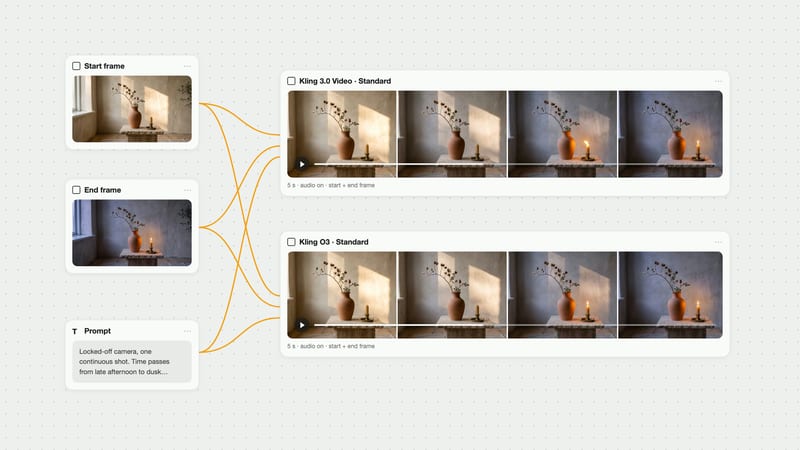
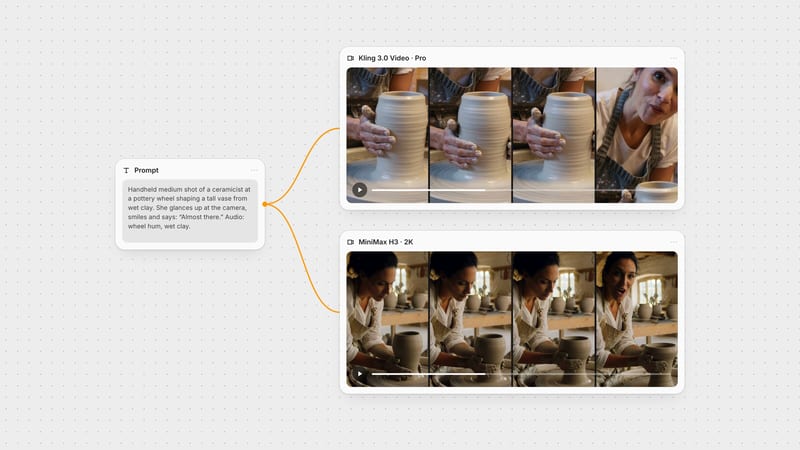
Put the prompt in a Text node and, if you use frames, add your start and end images. Wire them into a Kling 4.0 node and a Kling 3.0 Video node on the same canvas. Set both to the same duration, set Kling 3.0 to Pro and Kling 4.0 to 1080p for a like-for-like test, and switch Generate Audio on in Kling 3.0 if you want to compare sound. Run them side by side and keep the take that fits. If a shot needs more than 15 seconds or a reference image, only the Kling 4.0 node will take it. To write the prompt itself, the Kling 4.0 prompt guide covers timed beats and @Image references.
One run per round, per model, on 23 October 2026: Kling 4.0 at 1080p and Kling 3.0 at Pro with audio on, same prompts, frames and durations.
| Test | Kling 4.0 | Kling 3.0 |
|---|---|---|
| Results | ||
| 15 s take, four beats | One take; fitted the oars in the boat and rowed facing the stern. Footsteps and water on the track. | One take; held a third oar in an already-rigged boat and rowed facing the bow. Near-silent track. |
| Character from a photo (8 s) | Face, cap, glasses and mole held; glasses handled in the right order. | Face, cap, glasses and mole held; glasses back on too early, then a second pair appeared. |
| Judo throw (5 s) | Clean hip throw; thrower stays up, thrown judoka lands and gets to her knees. | Both judoka tangle and fall together; limbs merge mid-air. |
| Start and end frame (5 s) | Opens the bloom and drops petals; lands on the end frame. Fuller sound than asked. | Same result, with frames marginally closer to ours. Near-silent track. |
| Reference images | Up to 10 images and 5 clips, cited as @Image1 and @Video1. | Not available on the Fuser node. |
| Length and framing | 3 to 30 s; 16:9, 9:16, 1:1, 21:9 or Auto; 720p or 1080p. | 3 to 15 s; 16:9, 9:16 or 1:1; Standard, Pro and Turbo tiers. |
| Price per second | About two-fifths more than Kling 3.0 Pro with audio, at 1080p. Sound is always on. | The cheaper of the two, and cheaper still with audio off. |
| Pick it when | The shot has action, several steps, a reference image or more than 15 s. | You animate between two frames, want a negative prompt, CFG or Turbo, or need silence. |
In our same-input test it was better on a 15-second multi-step take, on a character performing a sequence of actions, and clearly better on a judo throw. On a start-and-end-frame transition the two were effectively tied, and Kling 3.0 costs less.
Kling lists clips of up to 30 seconds instead of 15, up to 10 reference images and 5 reference videos, stereo sound, 21:9, and better fast motion and physical interactions. In Fuser the Kling 4.0 node also has an Edit mode for restyling an existing clip.
Kling 4.0 runs 3 to 30 seconds in one generation. Kling 3.0 runs 3 to 15 seconds. Both nodes default to 5 seconds.
Yes. At 1080p, Kling 4.0 costs about two-fifths more per second than Kling 3.0 Pro with audio on, and about twice as much as Kling 3.0 Pro with audio off. At 720p it costs about a quarter more than Kling 3.0 Standard with audio.
Not in the node. Kling says audio-visual sync in Kling 4.0 is on by default with no separate toggle, so every clip comes with sound. If you need a silent clip from the model, Kling 3.0 has a Generate Audio switch.
No. The Kling 3.0 Video node takes a start and an end image only. For reference images cited in the prompt as @Image1, use Kling 4.0 or Kling O3.
Send one prompt and the same frames to Kling 4.0 and Kling 3.0 side by side, then keep the take that fits.