One click, whole workflow
Recipes are here. Package a whole workflow and run it in one click
Explore recipesOne click, whole workflow
Recipes are here. Package a whole workflow and run it in one click
Explore recipesFive tests, identical prompts, one run each: what Krea 3 and FLUX.3 Image produced for skin, a fashion editorial, text in a scene, a product edit and a group scene, and which to pick.
All guides · Krea in Fuser · FLUX.3 Image in Fuser
Quick answer: Krea 3 in Fuser won three of our five same-prompt tests against FLUX.3 Image: skin that reads photographed, a styled editorial that followed the brief, and a five-person scene with real motion. FLUX.3 Image won the edit, keeping a reference radio's angle, dial and labels, and took the text test narrowly with a cleaner handwritten card. At the settings we used, a generated image costs about the same in each; a Krea 3 edit costs about twice as much, because Krea also charges for each reference. Both are nodes on the same canvas, so one prompt can feed each and you keep the better frame.
Models: Krea 3, the default model in the Krea node, on the Berry variant at Medium reasoning, and FLUX.3 Image from Black Forest Labs, the newest FLUX image model in Fuser, with the FLUX.3 Image node's model set to FLUX.3 (not Klein).
Size and shape: Krea 3 ran at Auto, the size the node sets when you pick Krea 3, which lets Krea choose the aspect ratio from the prompt. We ran Krea first and set FLUX.3 to the same ratio at 2K. FLUX.3's node defaults to 1K; 2K matches the roughly 4 megapixels of Krea's Auto. Both returned 1824 × 2288 for 4:5 and 2048 × 2048 for 1:1; at 3:2 Krea returned 2512 × 1680 and FLUX.3 2512 × 1664.
Identical words: every prompt names its frame, Krea 3's negative prompt was left empty, and FLUX.3's Expand Prompt stayed off, its default. Krea 3 still rewrites each prompt before drawing; FLUX.3 used the words as written. PNG output from both.
Inputs: the edit test uses a studio photo of a radio from our own stock library, so neither model edited its own output.
One run each: one generation per model per test on 23 October 2026, no retries, no picking between takes. We compared full-resolution crops of faces, hands, labels and every letter.
Prompt: "Close medium portrait of a woman in her late fifties just out of the sea after a winter-morning swim, standing on a grey pebble beach, wet silver hair slicked straight back, cheeks, nose and ears flushed red from the cold, water droplets and goosebumps on her collarbones, a thick oatmeal towelling robe slipping off one shoulder, a faint smile, looking just past the lens. Unretouched skin with pores, fine lines, sun spots and a few broken capillaries. Flat grey overcast light, the sea a soft blur behind her. Shot on 1990s colour negative film, 85mm lens, fine grain, muted natural colour. Vertical 4:5 frame."
Krea 3 gave the skin the prompt listed: visible pores, broken capillaries on the nose and cheeks and a strong cold flush, in cool, soft colour that reads as 1990s negative film. The robe fell open off both shoulders rather than one.
FLUX.3 Image kept the robe on one shoulder as asked and drew crisp water droplets and sun spots, but etched deeper wrinkles with a sharper, more digital finish, so she reads older than her late fifties.
Verdict: Krea 3, narrowly. Both are convincing; Krea 3's skin and film colour are closer to a photograph of a real swimmer.
Prompt: "Fashion editorial in the stairwell of a 1960s public library: a model with a cropped bleached buzz cut sits sideways on worn terrazzo steps in a deconstructed ice-blue satin and tulle gown, its raw hems spilling down three steps, one sheer-stockinged foot resting on the step above, a stack of returned library books beside her. Hard direct on-camera flash, a crisp black shadow on the bottle-green painted wall behind her, a brass handrail catching the flash. 35mm snapshot, saturated colour, a bored, steady gaze into the lens. Vertical 4:5 frame."
Krea 3 followed the styling: a bottle-green wall, terrazzo steps, a deconstructed gown with exposed corset boning and raw hems, one stockinged foot on the step above and a stack of returned library books. Its flash is soft, and the shadow behind her barely shows.
FLUX.3 Image made the better flash snapshot, with grain, hard light and a shadow at her head, but painted the wall sage green, put her on worn grey steps, swapped the gown for a satin slip dress with tulle, and stacked leather-bound books.
Verdict: Krea 3. It missed the hard flash; FLUX.3 missed the wall, the steps and the gown. For a stylist's brief, the clothes and set matter more.
Prompt: "Street photograph of the front of a narrow shoe-repair shop on an overcast afternoon, shot square-on from across the pavement. Above the window, a deep-green painted fascia with hand-painted cream serif capitals reading "HEEL & SOLE". On the window glass in gold leaf: "Shoes · Keys · Watch Straps". Taped inside the glass door, a small handwritten card reads "Back in 10 minutes". Through the glass, shelves of polished shoes and a key-cutting machine. Natural light, 35mm, realistic colour. Square 1:1 frame."
Krea 3 spelled "HEEL & SOLE" and "Shoes · Keys · Watch Straps" correctly, middle dots included, on a convincing wet flagstone street. The small handwritten card reads "Back in 10 minutes" with a malformed n in "minutes".
FLUX.3 Image spelled all three lines correctly, the card in clean handwriting, and built a richer street around them: the neighbouring doors, a kerb, fallen leaves and a key board in the window.
Verdict: FLUX.3 Image, narrowly: both read the signage right, and FLUX.3 also got the smallest text right. For posters and dense type, see the FLUX.3 Image prompt guide.
Input: a studio photo of a warm grey tabletop radio with a black tuning dial on a chrome tube stand. Prompt: "Place this exact radio on a sunlit kitchen windowsill of white-painted wood, with a small lemon tree in a terracotta pot beside it and a blurred garden beyond the glass, warm morning sun casting the window frame's shadow across the sill. Change only the setting and the light. Keep the radio's shape, warm grey casing, perforated speaker grille, the black tuning dial with its numbers and red dots, the VOLUME and BAND labels, both knobs, the chrome tube stand and the cord exactly as they are. Vertical 4:5 frame."
Krea 3 built a lovely sunlit sill with the lemon tree, but turned the radio towards the camera, re-rendered the casing in metallic grey and spelled VOLUME as "VOLME". The dial layout and stand broadly survived.
FLUX.3 Image kept the radio's three-quarter angle, the chrome stand, the dial's numbers and red dots and the VOLUME and BAND labels. Its casing came out darker than the source's warm grey.
Verdict: FLUX.3 Image. Neither drew the window frame's shadow across the sill. Black Forest Labs' advice for FLUX.3 edits is to write the change as an instruction and "name exactly what to change" (BFL). We ran Krea 3 at Medium; its High reasoning level is built to keep unedited areas and correct required text, at a higher cost.
Prompt: "Documentary photograph of exactly five elderly men playing dominoes at a folding card table under a plane tree in a small village square, late afternoon. The man on the left slams a tile down mid-swing, his hand motion-blurred; the other four hold their tiles hidden in cupped hands: one in a flat cap, one in a white vest, one with reading glasses pushed up onto his forehead. Seven dominoes laid end to end on the green felt, their white pips clearly visible. Dappled sunlight through the leaves, 35mm colour slide film, warm natural colour. Horizontal 3:2 frame."
Both drew exactly five men, with a flat cap, a white vest and reading glasses up on a forehead.
Krea 3 made the stronger photograph: the slamming hand properly motion-blurred, the other tiles hidden in cupped hands, separate dominoes in a line, dappled light and a real slide-film look. It drew black pips on ivory tiles, not the white pips we asked for.
FLUX.3 Image drew black tiles with white pips as asked, but its line of dominoes fuses into one bent bar with irregular pips, the players hold their tiles in plain view, the throw barely blurs and the light is flatter.
Verdict: Krea 3.
Both nodes show the cost before you run. At the settings in this test, a Krea 3 image at Auto and a FLUX.3 Image at 2K cost about the same. Edits differ: Krea 3 also charges for every reference image by its size, so our one-reference edit cost about twice the FLUX.3 edit, which is priced by output resolution alone. Both get cheaper at smaller sizes: FLUX.3 at its 1K default costs about half its 2K price, and a Krea 3 preset such as Landscape 16:9 costs about a seventh of Auto.
Krea 3 for photographs of people: skin, styling, sets and candid group scenes. Name the medium and the frame, and use its negative prompt for what keeps creeping in. The Krea 3 prompt guide shows the formula and its fixes.
FLUX.3 Image when an edit must leave a product exactly as it was, or when small text has to be right. It combines up to ten references (BFL).
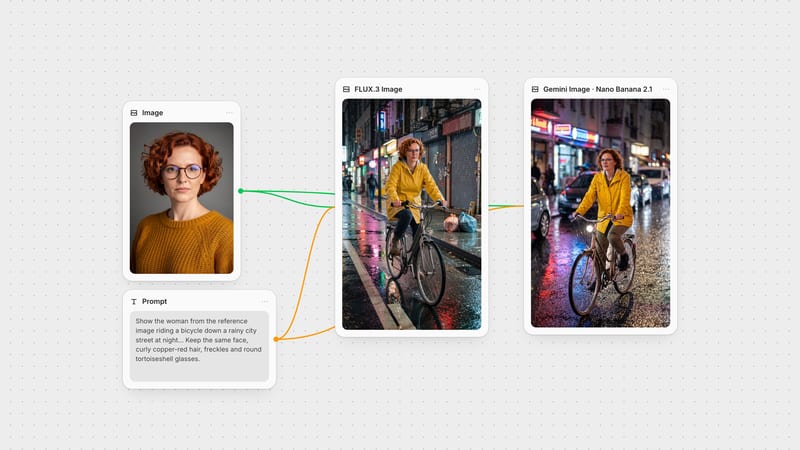
To run your own brief through both, wire one Text node (and any reference image) into a Krea node and a FLUX.3 Image node and compare the frames side by side on the canvas. For another rival on different prompts, see Krea 3 vs Nano Banana, and for FLUX.3 against Google's model, FLUX.3 Image vs Nano Banana 2.1.
One run per model per test, identical prompts and inputs, 23 October 2026.
| Test | Pick | What we saw |
|---|---|---|
| Same-prompt results | ||
| Photoreal skin | Krea 3 (narrow) | Pores, capillaries and a cold flush in film colour. FLUX.3 kept the robe right but aged her. |
| Styled editorial | Krea 3 | Right wall, steps and deconstructed gown; soft flash. FLUX.3 had the flash but changed the set and dress. |
| Text in a scene | FLUX.3 Image (narrow) | Both spelled the sign and window. Krea 3 malformed one letter on the small card. |
| Edit, keep the product | FLUX.3 Image | Kept the angle, dial and labels. Krea 3 turned the radio and wrote "VOLME". |
| Group scene | Krea 3 | Real motion blur and separate tiles. FLUX.3 fused the dominoes into one bar. |
In our five same-prompt tests, Krea 3 won three (skin, a styled editorial and a group scene) and FLUX.3 Image won two (an edit that had to keep a product, and narrowly the text test). Krea 3 is the stronger photographer; FLUX.3 is the more exact editor.
Both spelled a shop sign and a gold-leaf window line correctly. FLUX.3 also wrote a small handwritten card cleanly, where Krea 3 malformed one letter, and in the edit test Krea 3 misspelled a label. Put the exact words in quotation marks for either and check every letter.
FLUX.3 Image, in our test. It kept a radio's angle, dial and labels; Krea 3 at Medium reasoning turned it towards the camera and misspelled VOLUME.
For generating, about the same: a Krea 3 image at Auto and a FLUX.3 Image at 2K cost roughly the same. For edits, Krea 3 also charges for each reference image, so our one-reference edit cost about twice the FLUX.3 edit.
Yes. Krea 3 rewrites every prompt before it draws and returns the rewrite with the image. FLUX.3 Image only does so when you turn on Expand Prompt, which is off by default in Fuser.
Yes. Connect one Text node to a Krea node set to Krea 3 and to a FLUX.3 Image node, run both, and compare the frames side by side on the canvas.
One prompt, two image nodes, one canvas: keep the frame that fits.