One click, whole workflow
Recipes are here. Package a whole workflow and run it in one click
Explore recipesOne click, whole workflow
Recipes are here. Package a whole workflow and run it in one click
Explore recipesFive tasks, identical prompts, one run each: what Krea 3 and Nano Banana 2.1 produced for a portrait, a fashion editorial, a two-reference composite, a magazine cover and a surreal scene, and which to pick for each job.
All guides · Krea 3 prompt guide · Nano Banana 2.1 guide
Quick answer: Krea 3 in Fuser beat Nano Banana 2.1 on fashion and surreal photography in our five same-prompt tests, Nano Banana 2.1 won the magazine cover, and the portrait and the reference composite were ties. Krea 3 delivered the flash-lit editorial the brief described and kept its surreal scene under water; Nano Banana 2.1 set the cover full-bleed with the heavy masthead we asked for. At the sizes we tested, a Krea image costs about twice a Nano Banana 2.1 image at 2K in Fuser credits, so Nano Banana 2.1 is the cheaper everyday draft and Krea 3 the pick when the frame has to look art-directed. Both are nodes on the same canvas, so one prompt can feed each.
Models: Krea 3 from Krea, the default model in Fuser's Krea node, and Nano Banana 2.1 (gemini-nano-banana-2.1) from Google, the default model in Fuser's Gemini Image node. In Fuser the Gemini Image node calls Google directly; for this test we generated both with the same model versions Fuser uses, one run per model per task, on 23 October 2026.
Settings: Krea 3 on its Berry (quality) variant, Reasoning Level Medium, Image Size Auto, no negative prompt. Nano Banana 2.1 at 2K, aspect ratio 4:5, default thinking. PNG for both. Krea 3 returned 1824 × 2288 and Nano Banana 2.1 returned 1856 × 2304, so both are about four megapixels and close to 4:5. Every prompt opens with "Vertical 4:5", because Krea 3's Auto size picks its aspect ratio from the prompt.
Prompts and inputs: identical prompts, word for word. For the composite, both models got the same two input images, made with FLUX.2 [pro] so neither model edited its own output.
Judging: we compared full-resolution crops of skin, hands, fabric and type, and checked every letter of the requested text.
Prompt: “Vertical 4:5 photograph. Tight head-and-shoulders portrait of a woman in her late seventies, squinting into hard late-afternoon sun that rakes across her face from the left. Deep crow's feet, sun spots, fine downy hair on her cheek, chapped lips and visible pores, short wind-blown grey hair, the collar of a faded navy cotton shirt. Behind her, a shadowed harbour street falls into soft blur. 85mm lens, natural colour, no retouching.”
Krea 3 gave the stronger squint, deep crow's feet, downy hair on the cheek, chapped lips and fine pores, against a harbour of masts falling into blur. The light is hard but reads more frontal than raking, and the skin has a crisp, slightly gritty micro-contrast.
Nano Banana 2.1 caught warm, low sun across her face with clear sun spots, fine downy hair and natural-looking pores. She barely squints, and the chapped lips didn't come through.
Verdict: a tie. Krea 3 followed the expression and the lips; Nano Banana 2.1 followed the light. Pick by which of those your brief cares about more.
Prompt: “Vertical 4:5 fashion editorial photograph. A model in a voluminous rust-orange mohair coat over a black satin slip dress and chunky silver patent boots stands among waist-high stacks of grey slate offcuts in a quarry yard, wind lifting the coat's hem, one hand resting on the slate, a level, unsmiling gaze into the lens. Direct on-camera flash mixed with flat overcast daylight, a hard shadow cast on the slate behind her, every mohair fibre and slate edge crisp. 35mm, slight film grain, a restrained palette of slate grey, rust and black.”
Krea 3 made the frame read as a real flash editorial: the coat flares in the wind, the flash throws a hard shadow of her onto the slate stack behind her as the prompt asked, and the mohair, satin and chunky silver boots all hold up at full size.
Nano Banana 2.1 composed a clean, believable shot with the coat lifting and a hand on the slate, but under flat daylight with no visible flash shadow. It also burned a black film-frame border into all four edges, in both of our runs.
Verdict: Krea 3. It was the only one to deliver the lighting the brief described, and its frame needs no cropping. Krea describes Krea 3 as keeping "Krea 2's eye for style" (Krea); this test agrees.
Inputs: a full-length studio portrait of a man in a black knitted cap and brown work jacket, and a packshot of an oxblood stoneware pitcher with vertical ribs and a sandy foot.
Prompt: “Vertical 4:5 photograph. The man from the first image sits at a weathered outdoor wooden table under a fig tree at noon, pouring water from the pitcher in the second image into a small enamel cup. Dappled sunlight falls across the table and his hands. Keep his face, short white beard, black knitted cap and brown work jacket exactly as in the first image, and keep the pitcher's oxblood glaze, vertical ribs, handle and sandy unglazed foot exactly as in the second image. Documentary photograph, 35mm, natural colour.”
Krea 3 kept his face, white beard, ribbed cap, henley and jacket, framed him close at the table, and poured a clean stream into an enamel cup. The pitcher keeps its oxblood glaze, ribs and sandy foot, though the smooth band above the ribs is shorter than in the packshot and the glaze reads a little darker.
Nano Banana 2.1 kept the same details of the man and placed him smaller in a wider frame under the fig leaves, holding the cup as he pours. Its pitcher matches the packshot's brighter red and smooth upper band slightly more closely.
Verdict: a tie. Both held the person and the product well enough to use. Krea 3 gave the more intimate framing; Nano Banana 2.1 the slightly more faithful pitcher. In Fuser, Krea 3 takes up to eight reference images, which you can tag as <image-1> to <image-8> in the prompt, and the Gemini Image node takes up to ten.
Prompt: “Vertical 4:5 flat front cover of an independent quarterly magazine, shown full-bleed and square-on, not a mockup. Uncoated cream paper. A deep bottle-green band across the top fifth. Below it, left-aligned in a clean grotesque sans-serif: the line "A JOURNAL OF ROOMS, LIGHT & MAKING" in small capitals, then three cover lines in a lighter italic: "The last lime plasterers", "Why north light still wins" and "Twelve chairs, one carpenter". At the bottom, the masthead "HALDEN 14" in very large heavy black type. No other text, no barcode.”
Nano Banana 2.1 spelled every line correctly and returned the flat, full-bleed cover we asked for, with a heavy condensed masthead and a printed-looking edge on the green band. It set the top line in bold capitals rather than small capitals.
Krea 3 also spelled every line correctly, but presented the cover as a printed copy on a white surface, with a margin around it, and set "HALDEN 14" in a regular weight rather than heavy.
Verdict: Nano Banana 2.1. Both read perfectly; only Nano Banana 2.1 delivered the artwork itself at the weight we asked for. Both set the cover lines in a serif italic rather than a sans. Google lists "enhanced text rendering and infographic layout accuracy" for 2.1 (Gemini API), while its model card still flags small text at 1K (Google DeepMind).
Prompt: “Vertical 4:5 photograph looking straight down into a sunlit outdoor swimming pool. On the tiled floor, two metres under the water, a small café table is laid for breakfast: two cups and saucers, a white teapot tipped mid-pour with its tea unfurling through the water like a ribbon of brown smoke, a croissant on a plate, and a single lemon drifting just above the table. Bright sun caustics ripple across everything. A real photograph, pale turquoise and white with one accent of lemon yellow.”
Krea 3 made the image the prompt described: the tea unfurls through the water from a hovering teapot like a ribbon of brown smoke, the lemon drifts above the table, and caustics play over the porcelain. It shot from an angle rather than straight down.
Nano Banana 2.1 came closer to a top-down view and added two folding chairs we didn't ask for. Its lemon floats on the surface, ripple rings spread across the tabletop as if the table stood at the waterline, and the tea splashes into the cup rather than drifting.
Verdict: Krea 3. It kept the scene under water and sold the one surreal detail, the tea, that the image is built around.
Krea 3 for fashion and editorial frames where the light and styling are written into the brief, for surreal or conceptual photography, and for composites where framing matters. Use its Berry variant for finals; it is the only variant that reads a negative prompt.
Nano Banana 2.1 for covers, posters and anything with type to set, for quick drafts at about half the cost of Krea 3 at the sizes we tested, and for briefs that need many references or search grounding.
To run your own brief through both, wire one prompt node, and any reference images, into a Krea node and a Gemini Image node and compare the results side by side. The Krea 3 prompt guide covers variants, reasoning levels and reference tags, Krea 3 vs FLUX.3 Image tests Krea 3 against Black Forest Labs' newest model, and FLUX.3 Image vs Nano Banana 2.1 shows how Nano Banana 2.1 fares on likeness and product edits.
One run per model per task, identical prompts, 23 October 2026.
| Task | Pick | What we saw |
|---|---|---|
| Same-prompt results | ||
| Portrait texture | Tie | Krea 3 gave the squint and chapped lips; Nano Banana 2.1 the warm raking sun and sun spots. |
| Fashion editorial | Krea 3 | Only Krea 3 cast the flash shadow on the slate. Nano Banana 2.1 burned in a black film border. |
| Two references, one scene | Tie | Both kept the man and the pitcher. Krea 3 framed tighter; Nano Banana 2.1 kept the pitcher a touch closer. |
| Magazine cover text | Nano Banana 2.1 | Both spelled every line. Only Nano Banana 2.1 went full-bleed with a heavy masthead. |
| Surreal scene | Krea 3 | Tea unfurled like smoke under water. Nano Banana 2.1 put the table and lemon at the surface. |
| Cost per image in Fuser | Nano Banana 2.1 | Krea 3 at Auto size costs about twice Nano Banana 2.1 at 2K; a two-reference Krea 3 edit, about 2.7 times. |
In our five same-prompt tests, Krea 3 won the fashion editorial and the surreal scene, Nano Banana 2.1 won the magazine cover, and the portrait and the two-reference composite were ties. Nano Banana 2.1 costs about half as much per image at the sizes we tested, so it suits drafts and type-led work.
Nano Banana 2.1, in our test. Both spelled every line of our magazine cover correctly, but only Nano Banana 2.1 returned flat, full-bleed artwork with the heavy masthead we asked for. Krea 3 showed the cover as a printed copy with a margin around it.
Krea 3. In our fashion test it delivered the on-camera flash and the hard shadow the brief described, with crisp mohair and satin. Nano Banana 2.1 used flat daylight and added a black film border to the frame.
Nano Banana 2.1. At the sizes we tested, a Krea 3 image at Auto size costs about twice a Nano Banana 2.1 image at 2K in Fuser credits, and a Krea 3 edit with two references about 2.7 times. Krea 3 at a preset size such as Portrait 4:3 costs less than Nano Banana 2.1 at 1K, but renders only about 0.8 megapixels.
Krea 3 takes up to eight, which you can tag as <image-1> to <image-8> in the prompt. The Gemini Image node takes up to ten for Nano Banana 2.1.
Yes. Connect one prompt node, and any reference images, to a Krea node set to Krea 3 and a Gemini Image node set to Nano Banana 2.1, run both and compare the outputs side by side on the canvas.
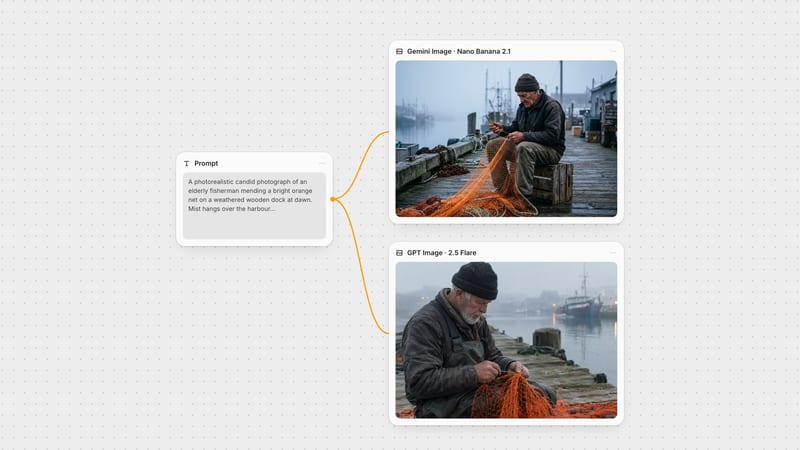
One prompt, two image nodes, one canvas: keep the frame that fits.