One click, whole workflow
Recipes are here. Package a whole workflow and run it in one click
Explore recipesOne click, whole workflow
Recipes are here. Package a whole workflow and run it in one click
Explore recipesFive prompts, two image models, one run each: what Seedream 5.0 Lite and Nano Banana 2.1 produced for text, counting, hands and a product edit, and which one to pick for each job.
All guides · Best AI image models
Quick answer: Nano Banana 2.1, the default model in Fuser's Gemini Image node, was the more precise instruction follower in our five-prompt test against Seedream 5.0 Lite: it was the only one to put exactly three apples on the plate, and it drew a convincing brass bench scraper. Seedream 5.0 Lite was the more literal composer: plainer sets, the tight close-up we asked for and heavily floured hands. Both set every word of a label and a five-line menu correctly, and both made a clean two-part product edit without disturbing the shoes or the plinth. Seedream 5.0 Lite charges one flat rate per image, which works out cheaper than Nano Banana 2.1 at 2K. Both are image nodes in Fuser, so one prompt can go to each in parallel and you keep the stronger frame. This is one run per prompt, so read it as each model's tendencies, not a ranking.
We ran five prompts through each model on 6 October 2026, one generation each, with no retries or cherry-picking:
Models: Seedream 5.0 Lite and Nano Banana 2.1 (gemini-nano-banana-2.1), the defaults in Fuser's Seedream and Gemini Image nodes. Nano Banana 2.1 replaces Nano Banana 2, which Google shuts down on 29 October 2026 (what changed). We generated these test images with the same model versions; Fuser's Gemini Image node calls Nano Banana 2.1 through Google directly.
Matched settings: the same five prompts as our first run of this test, word for word, with no seed for either model. Seedream 5.0 Lite used its landscape 4:3 preset and returned 3072 × 2304; Nano Banana 2.1 used 4:3 at 2K, its Fuser default, and returned 2400 × 1792. For the edit test, both got the same 1024 × 1024 input image and returned 2048 × 2048.
What we checked: every word and number against the prompt, object counts and positions, and what each model added or changed that the prompt did not ask for.
The prompt asked for a kraft coffee bag with three lines of label copy: "KILN ROAST", "Ethiopia Guji · Washed" and "250 g" in the bottom right corner, in soft window light from the left.
Seedream 5.0 Lite set all three lines correctly, including the middle dot, on a plain oak counter against a plain wall, which is all the prompt described.
Nano Banana 2.1 also set all three lines correctly, in a lighter serif, and placed the bag on a window ledge with a softly blurred kitchen behind it.
Verdict: a tie on text. Choose on styling: Seedream 5.0 Lite gives you the plainer packshot to composite; Nano Banana 2.1 adds a little lifestyle context.
A denser text test: a chalkboard titled "TODAY" with five items and right-aligned prices.
Seedream 5.0 Lite got every item and price right, with the prices in their own right-hand column, a chalk rule under each line and a plain brick wall around the board.
Nano Banana 2.1 also got every item and price right. It added dot leaders and a decorative "TODAY", hung the board on a cord, and framed it with a pendant lamp, shelves and pastries.
Verdict: a tie on accuracy. Seedream 5.0 Lite made the cleaner menu graphic; Nano Banana 2.1 made the more styled bakery scene. Google lists better text rendering among Nano Banana 2.1's updates (Gemini API docs); ByteDance highlights Seedream 5.0 Lite "accurately rendering attributes such as letters, time, numbers, and colors" (ByteDance Seed). Both held up here. For longer copy, see our text-in-images roundup.
The prompt asked for exactly three red apples and two green pears on a plate, a glass of milk on the right and a spoon on the left.
Seedream 5.0 Lite drew four apples and two pears. The glass and spoon were in the right places.
Nano Banana 2.1 drew three apples and two pears, with the glass on the right, the spoon on the left and nothing else on the cloth.
Verdict: Nano Banana 2.1. When the brief has a count, such as a product lineup or an item list, check Seedream's output before you use it.
A close-up of floured hands shaping a sourdough loaf, with a brass bench scraper on the left.
Seedream 5.0 Lite framed a true close-up with heavily floured hands and strong window light. Its scraper is a plain brass blade with a folded top edge: it reads as the tool, without much handle detail.
Nano Banana 2.1 framed a wider shot that takes in the baker's apron and a blurred kitchen, with lighter flour on natural-looking hands, and drew a realistic brass scraper with a rolled handle on the floured bench.
Verdict: split. Seedream 5.0 Lite followed the framing and texture more closely; Nano Banana 2.1 got the object more right.
Both models got the same product photo and one instruction: change the blue stripe to forest green suede and swap the grey backdrop for a sunlit terracotta wall, keeping everything else as it was.
Seedream 5.0 Lite made both changes and kept the shoes, laces, soles, concrete plinth and camera angle. It read "sunlit" as hard diagonal sun streaks across a deep orange wall.
Nano Banana 2.1 made both changes and kept the same elements, with the white leather still white. Its wall is a softer, paler terracotta with a single patch of sun.
Verdict: a tie on preservation. Choose on the light you want: hard and graphic from Seedream 5.0 Lite, soft and even from Nano Banana 2.1. For more editing models, see best AI image editing models.
Nano Banana 2.1 (gemini-nano-banana-2.1): Google's high-efficiency image generation and editing model, released on 6 October 2026, with 1K, 2K and 4K output, up to 14 reference images in the Gemini API and grounding with Google Web and Image Search (Gemini API docs). Every image carries a SynthID watermark (Gemini API docs). In Fuser, the Gemini Image node takes up to 10 input images, offers 1K, 2K or 4K and aspect ratios from 21:9 to 9:16, and has a Search Grounding toggle and an optional system prompt.
Seedream 5.0 Lite: released by ByteDance Seed in February 2026 with multi-step reasoning and reference-based style transfer. ByteDance calls it a "relatively small model" with "room for improvement in structural stability, realism, and aesthetics" (ByteDance Seed). In Fuser, the Seedream node defaults to 5.0 Lite, also offers 5.0 Pro and 5.0 Flash, takes up to 10 input images, and has auto sizes up to 4K plus fixed presets.
Price: Seedream 5.0 Lite charges one flat rate per image. Nano Banana 2.1 is priced by resolution: about the same as Seedream 5.0 Lite at 1K and roughly 1.4 times as much at 2K, on list prices on the day of our test.
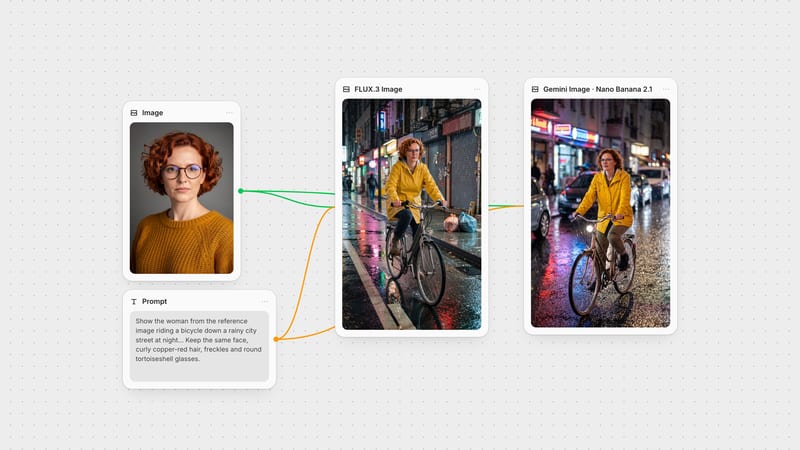
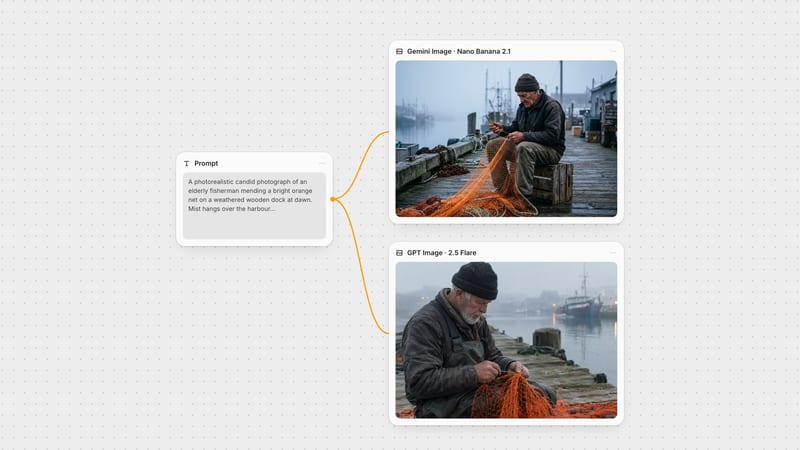
Your brief will separate these two models better than any general test. In Fuser, put the prompt in one text node and wire it into a Seedream node and a Gemini Image node side by side, as in the cover image, run both, and keep the one that fits. The winner can go straight into an image-to-video model or the Compositor on the same canvas. For model-specific prompting, see the Nano Banana prompt guide and the Seedream prompt guide; for other head-to-heads, see Nano Banana 2.1 vs Nano Banana 2 vs Pro, Nano Banana vs GPT Image and Flux vs Nano Banana.
Based on five prompts, one run per model, 6 October 2026.
| Task | Seedream 5.0 Lite | Nano Banana 2.1 |
|---|---|---|
| Our test | ||
| Short label text | All three lines correct; plain set as written. | All three lines correct; window ledge and blurred kitchen. |
| Five-line menu | All items and prices correct; ruled lines, plain wall. | All items and prices correct; dot leaders and bakery details. |
| Exact counts | Four apples instead of three. | Three apples and two pears, as asked. Pick this. |
| Hands close-up | True close-up, heavy flour; plain brass blade. | Wider shot, lighter flour; realistic brass scraper. |
| Product edit | Both edits; shoes and plinth kept; hard sun streaks. | Both edits; shoes and plinth kept; soft, even light. |
| Beyond the test | ||
| Style of output | Literal, sparse compositions. | Adds plausible context around the subject. |
| Price per image | One flat rate per image. | By resolution: about the same at 1K, roughly 1.4 times at 2K. |
Not across the board. In our test Nano Banana 2.1 followed a count and an object detail more precisely, while Seedream 5.0 Lite kept sets plainer and framed the close-up we asked for. Both rendered short and multi-line text correctly and both handled a two-part product edit cleanly. Fuser has both as nodes, so you can check them on your own prompt.
In our label and menu tests both got every word and number right. Nano Banana 2.1 tends to style the scene around the text, adding dot leaders and bakery details; Seedream 5.0 Lite keeps the text element as the main subject.
Both made the requested stripe and backdrop changes to our sneaker photo and kept the shoes, plinth and camera angle. Seedream 5.0 Lite lit the new wall with hard sun streaks; Nano Banana 2.1 gave a softer wall and kept the white leather white.
No. Nano Banana 2.1 (gemini-nano-banana-2.1) is Google's update to Nano Banana 2 (Gemini 3.1 Flash Image), released on 6 October 2026. In Fuser it is the default model in the Gemini Image node.
Seedream 5.0 Lite charges one flat rate per image. Nano Banana 2.1 is priced by resolution: on list prices when we ran the test, about the same as Seedream 5.0 Lite at 1K and roughly 1.4 times as much at 2K.
One prompt, two image nodes, one canvas: keep the one that fits.