One click, whole workflow
Recipes are here. Package a whole workflow and run it in one click
Explore recipesOne click, whole workflow
Recipes are here. Package a whole workflow and run it in one click
Explore recipesFive tasks, identical prompts and inputs, one run each: what FLUX.3 Image and Nano Banana 2.1 produced, and which to pick for each job.
All guides · Nano Banana 2.1 guide · Best AI image models
Quick answer: FLUX.3 Image won three of our five same-prompt tests in Fuser against Nano Banana 2.1, the default model in Fuser's Gemini Image node. It kept a reference face closest, left a product untouched in an edit, and caught the dawn light and soft background of a photo brief. Nano Banana 2.1 won the product shot, the only one to follow the set exactly, and the two tied on poster text: both spelled every line. A FLUX.3 Image at 2K costs about twice a Nano Banana 2.1 image at 2K in Fuser credits, so 2.1 is the cheaper everyday draft and FLUX.3 the pick for likeness and careful edits. Both are nodes on the same canvas, so one prompt can feed each.
Models: FLUX.3 Image from Black Forest Labs and Nano Banana 2.1 (gemini-nano-banana-2.1) from Google, each the model behind its Fuser node. In Fuser the Gemini Image node calls Google directly; for this test we generated both with the same model versions Fuser uses.
Settings: 2K and PNG for both, Expand Prompt off (FLUX.3's default), one run per model per task. FLUX.3 Image's node defaults to 1K; we raised it to 2K to match Nano Banana 2.1's default. Aspect ratio per task: 3:2 for the photo and product tests, 2:3 for the poster and character tests, and Auto for the edit. FLUX.3 returned 2512 × 1664, 1664 × 2512 and 2048 × 2048; Nano Banana 2.1 returned 2528 × 1696, 1696 × 2528 and 2048 × 2048.
Prompts and inputs: the five tasks from our Nano Banana 2.1 vs GPT Image 2.5 test, word for word, with the same input images, made with FLUX.2 [pro] so neither model edited its own output. The Nano Banana 2.1 outputs are the ones from that test, generated the same day.
One re-run: the first FLUX.3 poster job finished but its image could not be retrieved, so we ran that prompt once more. It is the only FLUX.3 poster we saw.
Judging: we compared full-resolution crops of hands, faces, labels and small type, and checked every letter of the requested text.
Prompt: "A photorealistic candid photograph of an elderly fisherman mending a bright orange net on a weathered wooden dock at dawn. Mist hangs over the harbour behind him, his calloused hands are in sharp focus, and the background falls off into soft blur. Natural light, 50mm lens look, muted colours."
FLUX.3 Image put a pink-lavender dawn glow over the mist, sharp hands with a netting needle, a detailed face under a flat cap, and a harbour that falls off into soft blur. A moored boat on the left carries a smudge of blurred lettering you can't read.
Nano Banana 2.1 framed the whole man on a crate in cool, overcast mist with a muted palette and nothing written anywhere. The background stays fairly sharp, and the light reads as grey morning rather than dawn.
Verdict: FLUX.3 Image, narrowly. It delivered the two things the prompt named that 2.1 missed: dawn light and a soft background.
Prompt: "A minimalist screen-printed concert poster on off-white paper. A large deep-blue wave shape fills the top half. Below it, the headline "NIGHT TIDE" in a bold condensed sans-serif, then "Live at Harbour Hall" in a lighter weight, then "Friday 14 November · Doors 8 PM", and at the bottom "harbourhall.com/nighttide" in small type. No other text."
FLUX.3 Image spelled every line correctly, including the URL, and returned flat, full-bleed artwork in one blue ink, ready to print. It set the middle dot as a larger bullet, and its wave closely imitates Hokusai's Great Wave rather than a new design.
Nano Banana 2.1 also spelled every line, kept the exact middle dot and drew its own stylised wave, but presented the poster as a sheet lying on a pale surface.
Verdict: a tie on accuracy. FLUX.3 gave the artwork itself; 2.1 gave the more original wave. For denser type and layout boxes, see the FLUX.3 Image prompt guide and FLUX.3 Image vs GPT Image 2.5.
Prompt: "Studio product photograph of a matte sage-green ceramic pour-over coffee dripper sitting on a pale oak board. Soft window light from the left, a gentle shadow to the right, clean off-white background, with empty space on the right third of the frame for ad copy. Real photograph, no props."
Nano Banana 2.1 followed the set: a separate pale oak board, light from the left, a shadow falling right and open space on the right third. Nothing branded.
FLUX.3 Image made a convincing matte dripper with a ribbed interior and left the right side empty, but stood it on the corner of a mid-tone oak table rather than a pale board, under soft, even light where the shadow barely reads.
Verdict: Nano Banana 2.1, the only usable-as-is result. FLUX.3 also missed the window light in this prompt in our FLUX.3 vs FLUX.2 test, so state lighting direction plainly and check it.
Input: a studio packshot of an amber serum bottle labelled "LUMA 02". Prompt: "Place this exact bottle on a wet, moss-covered river stone outdoors in soft morning sunlight, with a blurred forest stream behind it. Change only the setting and lighting. Keep the bottle's shape, amber glass, black dropper cap and the label text "LUMA 02" exactly as they are."
FLUX.3 Image kept the bottle's shape, amber glass, smooth glossy cap, dropper tube and a clean "LUMA 02" label, and set it against a properly blurred stream in dappled sun.
Nano Banana 2.1 kept the glass and a clean label, but restyled the cap's smooth collar with vertical ribs, and its rushing stream is only partly blurred.
Verdict: FLUX.3 Image. It was the only one to keep the cap exactly, as in our Nano Banana 2.1 vs 2 vs Pro test, where every Nano Banana model restyled it. BFL says FLUX.3 has no edit mode, mask or strength setting: "the prompt says what to do with the images" (BFL).
Input: a head-and-shoulders portrait of a woman with curly copper-red hair, freckles and round tortoiseshell glasses. Prompt: "Show the woman from the reference image riding a bicycle down a rainy city street at night, lit by neon shop signs, wearing a yellow raincoat with the hood down. Keep the same face, curly copper-red hair, freckles and round tortoiseshell glasses. Full-body shot, photorealistic."
FLUX.3 Image made the closer likeness: tight copper curls, visible freckles, round tortoiseshell glasses and the reference's neutral expression, with the raincoat hood down. Its shop signs are made-up glyphs rather than words.
Nano Banana 2.1 framed a natural full-body shot, but the face is small, the curls looser and the freckles faint. Its signs are illegible too.
Verdict: FLUX.3 Image. For several characters at once, Google rates Nano Banana 2.1 for consistency across up to four characters (Gemini API); see consistent characters with AI.
FLUX.3 Image when a face must match a reference, when an edit has to leave the product exactly as it was, or when you need print-ready poster artwork. It combines up to ten references (BFL) and has no negative prompt field, so describe what you want instead (BFL).
Nano Banana 2.1 for everyday generation, product sets that must follow the brief literally, and drafts: it costs about half as much as FLUX.3 at 2K. It replaces Nano Banana 2, which Google shuts down on 29 October 2026 (release notes).
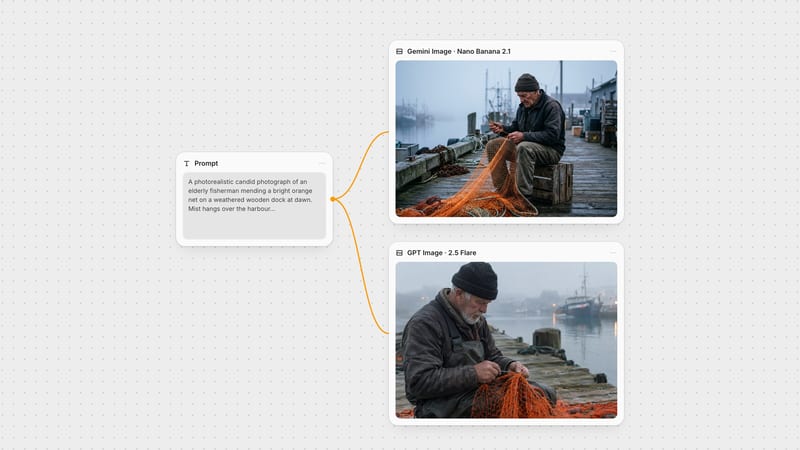
To run your own brief through both, wire one prompt node (and any reference image) into a FLUX.3 Image node and a Gemini Image node and compare the results side by side, as in the image at the top. The Nano Banana 2.1 guide covers what's new in 2.1.
One run per model per task, identical prompts and inputs, 6 October 2026.
| Task | Pick | What we saw |
|---|---|---|
| Same-prompt results | ||
| Photoreal scene | FLUX.3 Image (narrow) | Dawn glow and a soft background as asked. 2.1 framed the whole scene but read overcast, with a fairly sharp background. |
| Text on a poster | Tie | Both spelled every line. FLUX.3 returned flat print-ready art with a Great Wave pastiche; 2.1 showed a sheet with its own wave. |
| Product shot | Nano Banana 2.1 | Only 2.1 used a separate pale board with light from the left and the shadow to the right. |
| Edit the setting | FLUX.3 Image | FLUX.3 kept the smooth cap and blurred the stream. 2.1 ribbed the cap collar. |
| Same person, new scene | FLUX.3 Image | Closer face, curls, freckles and glasses. Neither rendered readable signs. |
In our five same-prompt tests, FLUX.3 Image won three (the photo, the edit and the character test), Nano Banana 2.1 won the product shot, and the poster was a tie. Nano Banana 2.1 costs about half as much per 2K image in Fuser, so it suits drafts and literal product sets.
Both spelled every line of our poster correctly, including the URL. FLUX.3 Image returned flat artwork ready to print; Nano Banana 2.1 kept the exact middle dot but showed the poster as a photographed sheet. Put the exact words in quotation marks for either model.
FLUX.3 Image, in our test. It kept our serum bottle's smooth cap, dropper and "LUMA 02" label exactly. Nano Banana 2.1 kept the label clean but restyled the cap collar with ribs.
FLUX.3 Image made the closer likeness from one reference portrait: curls, freckles, glasses and expression all carried over. Nano Banana 2.1's version had looser curls and fainter freckles.
Nano Banana 2.1. A FLUX.3 Image at 2K costs about twice a Nano Banana 2.1 image at 2K in Fuser credits, and about 1.4 times as much at 1K.
Yes. Connect one prompt node to a FLUX.3 Image node and a Gemini Image node set to Nano Banana 2.1, run both and compare the outputs side by side on the canvas.
One prompt, two image nodes, one canvas: keep the result that fits.