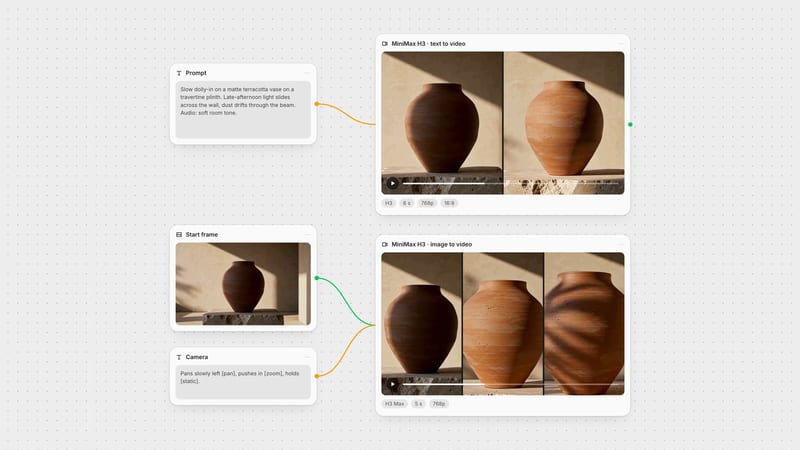
One click, whole workflow
Recipes are here. Package a whole workflow and run it in one click
Explore recipesOne click, whole workflow
Recipes are here. Package a whole workflow and run it in one click
Explore recipesbyMiniMax
Generate fluid human motion, micro-expressions, and physical camera sweeps with locked lighting and zero mechanical jitter
From static frames or pure directorial prompts to full cinematic video in three deliberate moves.
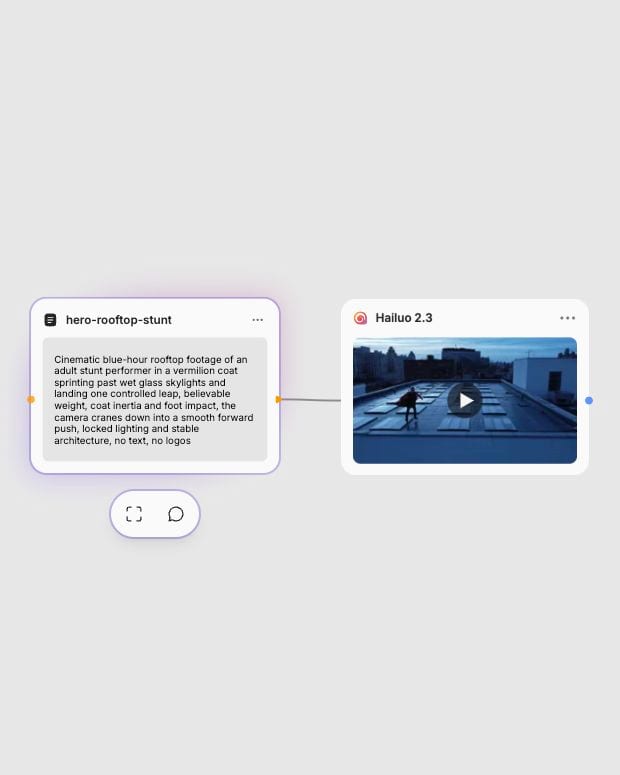
Frame your opening shot
Upload a high-resolution starting image for frame-accurate animation, or begin with a pure text prompt.
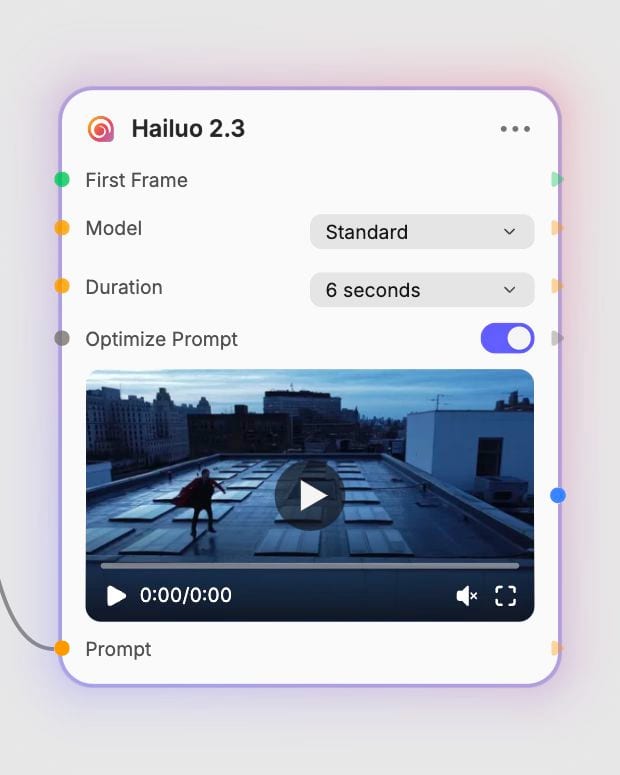
Direct motion and optics
Add bracketed camera commands like [Pan left] and specify physical details such as fabric inertia or liquid splashes.
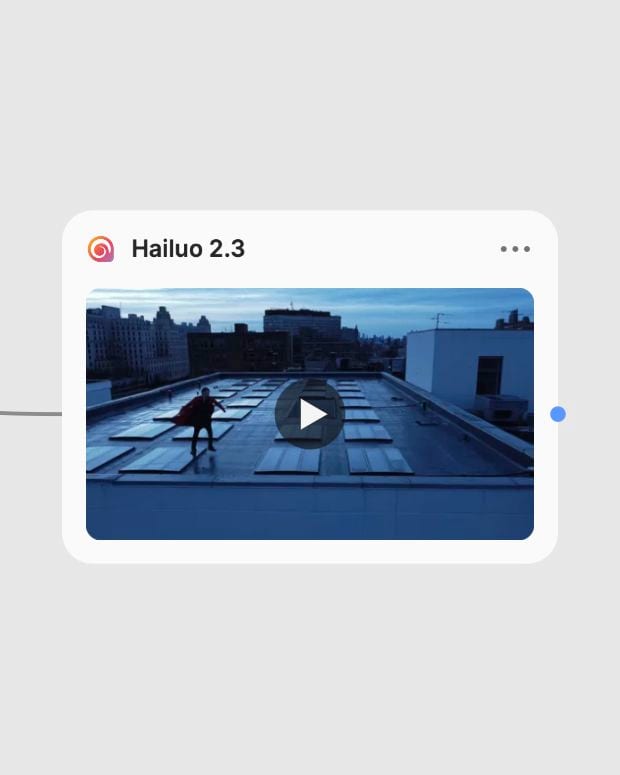
Select tier and render
Choose Fast variants for rapid 768p layout drafting or flagship Pro tiers for uncompromised 1080p cinematic fidelity.
Engineered with true physical inertia, native director camera framing, and micro-expression fidelity that keeps subjects grounded.
Explore how physical lighting, garment dynamics, and fluid camera sweeps perform across photorealistic and stylized video renders.
How filmmakers, fashion directors, commercial VFX artists, and animators harness physics-grounded video generation.
The Pro variant delivers native 1080p resolution with maximum sampling depth for final cinematic production, whereas the Fast variant generates 768p video at significantly higher speeds for rapid drafting. Pro supports both text-to-video and image-to-video workflows, while Fast is strictly dedicated to image-to-video iteration at lower computational cost.
Use the Pro Image-to-Video tier when maximum texture detail, 1080p clarity, and subtle micro-expressions are essential. For rapid storyboard exploration and checking motion trajectories before committing to final renders, the Fast Pro or Fast Standard Image-to-Video variants offer faster turnaround at 768p.
Direct camera motion by placing bracketed director keywords at the beginning or end of your prompt, such as [Pan left], [Push in], or [Dolly zoom]. You can combine up to three directives within a single bracket to specify complex spatial trajectories without confusing the model's action rendering.
The Standard variant supports either 6-second or 10-second video generations. The 10-second duration is best suited for ambient scenes and continuous camera sweeps, as shorter 6-second clips minimize the likelihood of motion drift during complex physical action.
The model is not designed for multi-stage sequential actions within a single generation, such as a character running, stopping, and sitting down in sequence. It also avoids fine typography, vector logo animation, and exact last-frame loop matching, as it focuses its physical simulation on continuous motion starting from the first frame.
Generate fluid human motion, micro-expressions, and physical camera sweeps with locked lighting and zero mechanical jitter