One click, whole workflow
Recipes are here. Package a whole workflow and run it in one click
Explore recipesOne click, whole workflow
Recipes are here. Package a whole workflow and run it in one click
Explore recipesSeven same-prompt tests through both Model options of Fuser's FLUX.3 Image node: dense poster text, counted objects, a product shot, a portrait, a relight edit, a four-reference composite and 4K, plus speed, relative cost and arena scores.
All guides · FLUX.3 Image in Fuser · FLUX.2 in Fuser
Quick answer: FLUX.3 Klein in Fuser is the FLUX.3 to reach for on drafts, volume work and multi-reference edits. In our same-prompt tests on 23 October 2026 it ran 4 to 17 times faster than full FLUX.3 and costs between a fifth and two-fifths as much at 1K, depending on the aspect ratio. It matched FLUX.3 on counted objects and on a four-reference composite, and its photos were close. Full FLUX.3 earned its price in three places: it set a dense poster exactly in every run where Klein, with its default Expand Prompt on, added a stray quote mark every time; it relit a kitchen from midday to blue hour where Klein left the sun patch on the table; and its 4K output has more pixels and finer material detail. Both are Model options in one node, the FLUX.3 Image node, one of 133 image models in Fuser, so you can wire one prompt into both and keep the better result.
On the Artificial Analysis text-to-image arena, FLUX.3 Klein scores 1,043 Elo, 74 points below full FLUX.3 Image at 1,117 and 114 points above FLUX.2 [klein] 9B at 929. That puts it level with Qwen-Image-2.1 and Fibo 2.0, and above FLUX.2 [max] and [pro].
On the same site's image-editing arena, the gap is narrower: FLUX.3 Klein scores 1,072 against FLUX.3 Image's 1,122 and FLUX.2 [klein] 9B's 1,015, with wider confidence intervals than the text-to-image board (image arena, editing leaderboard, both read 23 October 2026).
Black Forest Labs describes FLUX 3 Image Klein as "a compact, open-weights version" of FLUX 3 Image: 5.6 billion parameters, text-to-image, image editing, multiple references, bounding boxes and output up to 4K, released on 15 October 2026 under BFL's FLUX Kommunity License. It comes as a step-distilled model that runs in 16 steps and an undistilled base model for fine-tuning. Hugging Face's launch post measured a 1024 × 1024 image in about 2 seconds on an H100. One line in BFL's docs explains a default you'll see in Fuser: "Do not use Klein without the prompt upsampler. The model is trained on the captions it writes; a prompt sent as typed gives noticeably weaker results."
In Fuser, Klein isn't a separate node. Open the FLUX.3 Image node and set Model to FLUX.3 Klein. What changes:
Expand Prompt is on by default. It rewrites your prompt into a detailed caption before generating, grounded in the reference images when you edit. Full FLUX.3's own Expand Prompt toggle stays off by default.
A seed. Klein takes one, so the same prompt and seed repeat the same image. Full FLUX.3 has no seed.
Image size follows Resolution and Aspect Ratio. The long side matches the tier (1024 px at 1K, 2048 px at 2K, 4096 px at 4K) and the short side follows the ratio, so Klein's 1K at 4:5 is 816 × 1024 where FLUX.3's is 912 × 1152. At 4K and 16:9, Klein returned 4096 × 2304 and FLUX.3 5456 × 3072.
References route automatically. Connect 1 to 10 images and the node switches to editing. With Aspect Ratio on Auto, Klein follows the reference's own size.
Billing by output size. Klein is billed per output megapixel, rounded up to whole megapixels, and references aren't billed. Full FLUX.3 is billed per resolution tier.
Seven tests, each sent to both Model options of the FLUX.3 Image node on 23 October 2026 with identical prompts and input images, generated with the same model versions Fuser runs. Each model ran once per setting unless a caption says otherwise, with no retries. FLUX.3 ran with Expand Prompt off and Klein with it on, the node defaults, except where we tested the toggle itself. Klein used fixed seeds, given in each caption; FLUX.3 can't take one. We read every output at full size and counted words, objects and errors. Generated people are AI-generated and fictional.
"A Swiss-style risograph poster on cream paper for a ceramics fair. Headline in large bold black grotesque capitals: "SLOW CLAY". Below it, a three-line subhead in a smaller regular weight: "Thrown, glazed and fired by hand" / "Forty-two studios from the north coast" / "Saturday 8 November, 10:00 to 18:00". At the bottom, small print: "Old Rope Works, Quay Street, Harlow Bay · Free entry for under 12s". In the lower right corner, a round sticker reading "Tickets 6.50". One terracotta-orange accent: a single hand-thrown vase photographed in hard daylight, cut out and placed on a strict grid with generous margins." 1K, 4:5, three runs per model.
Every one of the six posters spells every word correctly. FLUX.3 set the text exactly in all three runs, and its layouts are the better designs: a headline stacked on the grid, the subhead in its own cell and riso grain in the vase's shadow. Klein, with Expand Prompt on, added a closing quote mark after "by hand" in all three runs, with three different seeds.
The stray mark comes from the prompt expander, which copied our slash-separated lines into its caption with their quote marks. With Expand Prompt off, the same seed came back exact. So for exact text, turn Expand Prompt off on Klein, even though BFL recommends the upsampler for general quality.
Verdict: FLUX.3, for exact text with node defaults and stronger layouts. Klein with Expand Prompt off was exact too.
"Eye-level still life on a white seamless paper sweep, studio photograph on medium-format film. Exactly three red enamel mugs stand in a row on the left. Exactly two blue glass jars stand on the right. A single yellow lemon is balanced on top of the middle red mug. A folded cream card leans against the blue jars with a handwritten note in black ink that reads "back at 4 — L." Soft north-window light from the left, a pale grey shadow falling to the right. Nothing else in the frame." 1K, 16:9, each model with Expand Prompt off and on.
All four images get every count, colour and position right, and all four write the note correctly, including the long dash. The differences are small. Klein with Expand Prompt on fused the three mugs together at the handles, and its card stands on its own instead of leaning on the jars. FLUX.3 with Expand Prompt on broke the note over two lines and showed the edge of the paper sweep.
Verdict: tie. Klein with Expand Prompt off was as clean as either FLUX.3 run.
"An unbranded cream-coloured portable radio from the 1960s with a brushed aluminium dial strip, a woven tan fabric speaker grille and a leather carry strap, standing on a pale plaster plinth. One cobalt-blue tuning knob is the only accent. Documented plainly in high-key studio light on seamless off-white paper, a soft shadow falling to the right. Medium-format studio photograph, sharp from front to back, every thread of the grille and every scratch in the aluminium visible." 2K, 16:9.
Both got the radio, the grille, the strap and the single cobalt knob right. FLUX.3 printed a tuning scale on the dial and added small scuffs and a worn edge, which makes it read as a real 1960s object. Klein left the aluminium strip blank and the body clean, closer to a render, though its grille weave holds up at full size. At the 2K tier, FLUX.3's file is 2736 × 1536 against Klein's 2048 × 1152.
Verdict: FLUX.3, narrowly.
"Film still on 35mm: a fictional woman in her sixties with cropped silver hair and a heavy oatmeal wool fisherman's sweater stands in the open doorway of a stone boathouse in thick morning fog, both hands wrapped around a chipped white enamel cup, her breath faintly visible in the cold air, looking just past the camera. Soft overcast light from the open water behind the camera, muted bone and slate palette, one coil of rust-red rope on the wet flagstones. Visible skin texture, loose wool fibres, fine grain." 2K, 16:9.
Both drew believable hands around the cup and convincing skin. FLUX.3 knitted a proper cable-knit fisherman's sweater and chipped the enamel rim, but placed her outside the boathouse rather than in its doorway. Klein put her in the doorway as asked, with a plain knit sweater, a speckled cup instead of chips, and her breath as a puff of steam floating beside her head.
Verdict: FLUX.3 on material detail; Klein on the staging.
One AI-generated kitchen photo (1024 × 576) as the reference, and this instruction for both: "Make it blue hour: through the window the sky is a deep dusk blue, the sunlight on the table is gone, and a single warm brass pendant lamp now hangs above the table, switched on, casting a pool of warm light over the bowl of pears. Keep the table, chairs, bowl, pears, walls, cabinet, floor and window frame exactly as they are." Aspect Ratio on Auto.
FLUX.3 did all of it: a dusk sky, a lamp, a warm pool of light over the pears, and the midday sun patch gone from the table, with the furniture and window frame where they were. Klein added the lamp and cooled the walls in both runs, but kept the bright window and the rectangle of sunlight on the table, with Expand Prompt on or off. The edit asks the model to remove light as well as add it, and only FLUX.3 did.
Verdict: FLUX.3.
Four references: an AI-generated portrait of a man, a butter-yellow teapot, an empty terrazzo café counter and a gouache painting. Instruction: "The man from image 1 stands behind the terrazzo café counter from image 3, pouring tea from the butter-yellow teapot in image 2 into a small glass. Render the whole scene in the gouache style of image 4: flat opaque colour, visible brush strokes, slightly wobbly hand-drawn outlines, a palette of ochre, sage, terracotta and cream. Keep his beard, round tortoiseshell glasses and navy work jacket, and the teapot's cane handle." 1K, 4:5.
Both kept him recognisable, with the beard, glasses and jacket, and both kept the teapot's cane handle, the terrazzo, the tiled wall and the row of upturned glasses. FLUX.3's version is the more painterly, with flatter colour and looser outlines. Klein's sits closer to an illustrated photo and also copied the deckled paper edge from the gouache reference. Klein returned its image in 11 seconds, FLUX.3 in 57.
Verdict: tie. For multi-reference work, Klein is the better value.
"A naturalist's specimen tray on raw undyed linen, photographed straight down in soft north-window light: neat rows of grey-green lichens, cushions of moss, a curled fern frond, a single speckled brown feather, a cracked snail shell and three small smooth grey pebbles. Each specimen has a tiny paper tag tied with cotton thread, handwritten in brown ink: "Cladonia, north wall", "Hypnum, oak root", "Polypody, 3 Oct", "wren?", "Cepaea", "beach, Harlow Bay". Bone, moss-green and umber palette. Medium-format film, sharp from edge to edge, every fibre of the linen visible." 4K, 16:9.
FLUX.3 returned 5456 × 3072 (16.8 MP) after 197 seconds. It curled the fern as asked, tied every tag to its specimen with thread and rendered the linen weave cleanly at 100%, but misspelled two tags: "Cepaaa" and "oak woot". Klein returned 4096 × 2304 (9.4 MP) in 13 seconds. It spelled five of six tags correctly and turned "Polypody" into a scribble, left the tags lying loose beside the specimens and laid the fern flat. At this size, Klein costs about a seventh as much as FLUX.3.
Verdict: FLUX.3 for detail and layout; Klein for the price.
Same product prompt at 1:1, three runs per setting, with node defaults. Klein's median includes about a second of prompt expansion.
Klein's median was 2.4 seconds at 1K and 6.4 at 2K; FLUX.3's was 40.0 and 27.5. FLUX.3's runs ranged from 23 to 65 seconds, so its 1K median coming out slower than its 2K median is queue noise, not a property of the model. Across every run in this article, Klein never took longer than about 13 seconds. This is an informal test through one provider on one day, not a benchmark.
Normalised to one 1-megapixel image, Klein is among the cheapest models in Fuser and about a fifth of full FLUX.3 at 1K.
Because Fuser bills Klein in whole megapixels and FLUX.3 by tier, the ratio depends on the size you pick. Klein's cost as a share of FLUX.3's, in Fuser credits:
768px, square: about 0.22×.
1K at 4:5, 16:9 or another non-square ratio (up to 1 MP): about 0.19×, so 100 Klein images cost about as much as 19 from FLUX.3.
1K square (1024 × 1024, billed as 2 MP): about 0.38×, or 100 Klein images for the price of 38.
2K: about 0.27× at 16:9 and 0.45× square.
4K: about 0.15× at 16:9 and 0.25× square.
Edits: references aren't billed. A single-reference edit with Aspect Ratio on Auto is billed as a 4 MP output, about three-quarters of a FLUX.3 edit at 1K, so pick an aspect ratio to pay for the size you get. With several references on Auto, Klein bills 1 MP.
FLUX.3 also delivers more pixels per tier (912 × 1152 against 816 × 1024 at 1K, 4:5), so per megapixel Klein is cheaper still. Lower planned per-image rates for Klein have been announced but aren't confirmed; Fuser bills the confirmed per-megapixel rate.
FLUX.2 [klein] comes in 4B and 9B sizes and is still in Fuser as a Model Type on the FLUX.2 node. Against it, FLUX.3 Klein scores 114 Elo points higher on text-to-image (1,043 against 929 for the 9B) and 57 higher on editing (1,072 against 1,015). It adds bounding-box layout control and 4K output, where BFL's FLUX.2 overview lists up to 4 MP for the family. FLUX.2 [klein] 9B costs about two-thirds as much per megapixel. For anything you'll keep, FLUX.3 Klein is the upgrade; FLUX.2 [klein] remains the cheapest FLUX for throwaway drafts. Our FLUX.3 vs FLUX.2 test compares the two flagship generations.
Pick FLUX.3 Klein when:
you're iterating on a composition and want an answer in seconds;
you need many images, variations or seeds, since Klein repeats an image from its seed;
you're combining several references into one scene;
you need a 4K deliverable on a budget and can check it at 100%;
you need exact text and can switch Expand Prompt off.
Pick full FLUX.3 Image when:
the final has to be print-ready typography or a designed layout;
an edit has to remove or relight something, not only add it;
material detail decides the shot: knits, enamel, a believable dial, the weave of linen at 4K;
you want the most pixels per tier.
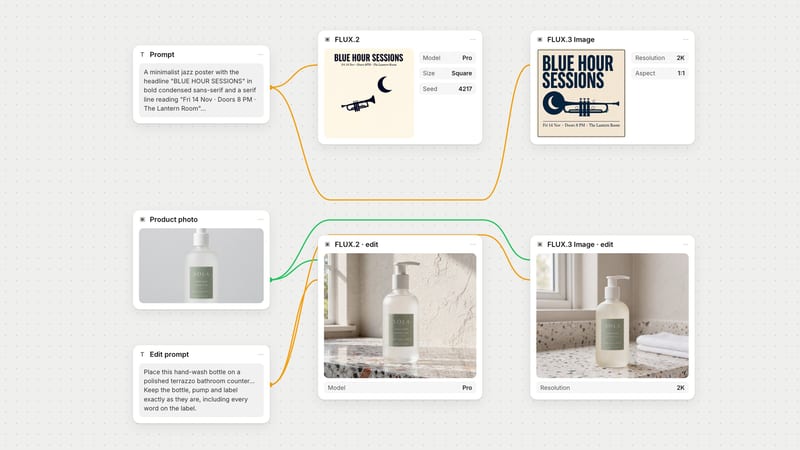
Wire one Text node into two FLUX.3 Image nodes, set one to FLUX.3 and one to FLUX.3 Klein, and run them together, as in the canvas at the top of this page. A common pattern is to draft on Klein, keep the seed you like, then send the same prompt to FLUX.3 for the final. For prompt structure and layout boxes, read the FLUX.3 Image prompt guide; for references and box edits, the FLUX.3 Image editing guide. To see full FLUX.3 against other flagships, read FLUX.3 Image vs GPT Image 2.5 and FLUX.3 Image vs Nano Banana 2.1.
Last verified October 23, 2026.
Seven same-prompt tests in the FLUX.3 Image node on 23 October 2026, one run per setting except the poster (three each).
| Category | FLUX.3 Klein | FLUX.3 Image |
|---|---|---|
| Test results | ||
| Image quality | Close on photos; cleaner, more render-like surfaces. | Finer material detail: cable knit, chipped enamel, a printed dial. |
| Prompt adherence | Every count right; fused mugs with Expand Prompt on. | Every count right, with Expand Prompt on or off. |
| Text | Words right in 4 of 4 posters; a stray quote in all 3 with Expand Prompt on, exact with it off. 5 of 6 tags at 4K. | Exact in 3 of 3 posters, stronger layouts. 4 of 6 tags at 4K. |
| Editing | Added a lamp but kept the midday sun; matched FLUX.3 on a 4-reference composite. | Relit midday to blue hour fully; more painterly composite. |
| Speed, cost and specs | ||
| Speed (median) | 2.4 s at 1K, 6.4 s at 2K, 13 s at 4K. | 40.0 s at 1K, 27.5 s at 2K, 197 s at 4K. |
| Relative cost at 1K | About 0.19× of FLUX.3 non-square, 0.38× square. | 1× (billed per tier). |
| Max resolution | 4K: 4096 px long side (4096 × 2304 at 16:9). | 4K: 5456 × 3072 at 16:9. |
| Seed | Yes. | No. |
| Arena Elo (text-to-image / editing) | 1,043 / 1,072 | 1,117 / 1,122 |
| Best for | Drafts, volume, seeds, multi-reference edits, budget 4K. | Final typography, relighting edits, hero images. |
FLUX.3 Klein is Black Forest Labs' compact, open-weights version of FLUX 3 Image: 5.6 billion parameters, text-to-image, editing with multiple references, bounding boxes and output up to 4K. In Fuser it is a Model option in the FLUX.3 Image node, set from the Model dropdown.
In Fuser, FLUX.3 Klein costs about a fifth of FLUX.3 at 1K for non-square images and about two-fifths for a 1024 × 1024 square, because Klein is billed per output megapixel, rounded up, and FLUX.3 per resolution tier. At 4K it costs a seventh to a quarter of FLUX.3. Reference images aren't billed.
Yes. On the Artificial Analysis arenas, FLUX.3 Klein scores 1,043 on text-to-image against 929 for FLUX.2 [klein] 9B, and 1,072 on editing against 1,015. It also adds bounding boxes and 4K output. FLUX.2 [klein] 9B costs about two-thirds as much per megapixel and stays available in Fuser's FLUX.2 node.
Yes. Connect 1 to 10 images to the FLUX.3 Image node with Model set to FLUX.3 Klein and it switches to editing automatically. In our tests it matched FLUX.3 on a four-reference composite, but in a midday-to-blue-hour relight it added the lamp and kept the sunlight that full FLUX.3 removed.
Yes. At the 4K tier, Klein's long side is 4096 px, so 4096 × 2304 at 16:9. In our test it took 13 seconds and cost about a seventh of FLUX.3 at 4K, which returned 5456 × 3072 in 197 seconds with finer detail.
FLUX.3 set a dense poster exactly in three of three runs. FLUX.3 Klein spelled every word but, with Expand Prompt on (its default), added a stray quote mark in all three runs. With Expand Prompt off it was exact. For final typography, use FLUX.3; for exact text on Klein, switch Expand Prompt off.
Yes. Black Forest Labs released FLUX 3 Image Klein's weights on 15 October 2026 under its FLUX Kommunity License, as a fast distilled model and an undistilled base model for fine-tuning. In Fuser you run it from the FLUX.3 Image node without managing any hardware.
Yes. With Model set to FLUX.3 Klein, the FLUX.3 Image node shows a Seed control, so the same prompt and seed repeat the same image. Full FLUX.3 has no seed.
Wire one prompt into two FLUX.3 Image nodes, set one to Klein, and keep the result that's right for the job.