One click, whole workflow
Recipes are here. Package a whole workflow and run it in one click
Explore recipesOne click, whole workflow
Recipes are here. Package a whole workflow and run it in one click
Explore recipesNano Banana 2.1 is now the default model in Fuser's Gemini Image node. What changed from Nano Banana 2, the 29 October shutdown, and how to prompt it.
All guides · Nano Banana prompt guide
Quick answer: Nano Banana 2.1 is live in Fuser as the default model in the Gemini Image node, so every new image node runs Google's newest Nano Banana without changing a setting. Google released it on 6 October 2026 as the successor to Nano Banana 2, with better visual quality, prompt adherence, text rendering and multi-turn character consistency, at about half Nano Banana 2's per-image price. Nano Banana 2 shuts down on 29 October 2026.
Nano Banana 2.1 (model ID gemini-nano-banana-2.1) is Google's high-efficiency Gemini model for image generation and conversational image editing. Google describes it as an update to Nano Banana 2 (Gemini 3.1 Flash Image) that keeps Flash-level speed and cost, and as the more efficient counterpart to Nano Banana Pro (Gemini 3 Pro Image). It went generally available on 6 October 2026 in both the Gemini API and Google Cloud.
It takes text and images as input and returns images at 1K, 2K or 4K. Every image carries Google's SynthID watermark, and Google Cloud lists support for C2PA content credentials.
From Google's model card and release notes:
Visual quality and realism: improved across 1K, 2K and 4K output.
Prompt adherence: closer to what you actually wrote, which matters most for edits where you specify what to keep.
Text and infographics: Google calls out more accurate text rendering and infographic layout, useful for posters, packaging and slides.
Multi-turn character consistency: a character stays recognisable across a sequence of edits and scenes.
Multi-image fusion: Google rates character consistency for up to 4 characters and object fidelity for up to 10 objects across reference images.
Search grounding: Google Web and Image Search can anchor real products, places and current events.
Google prices Nano Banana 2.1's image output at half Nano Banana 2's rate at every resolution, so the upgrade costs less than staying put.
Google's release notes deprecate gemini-3.1-flash-image (Nano Banana 2) and set its shutdown for 29 October 2026, with Nano Banana 2.1 as the named replacement. In Fuser, new Gemini Image nodes already default to Nano Banana 2.1. Saved nodes keep the model they were set to, so open any canvas or Recipe that uses Nano Banana 2 and switch the node's Model dropdown to Nano Banana 2.1.
Open a canvas and add a Gemini Image node. Its Model is already set to Nano Banana 2.1.
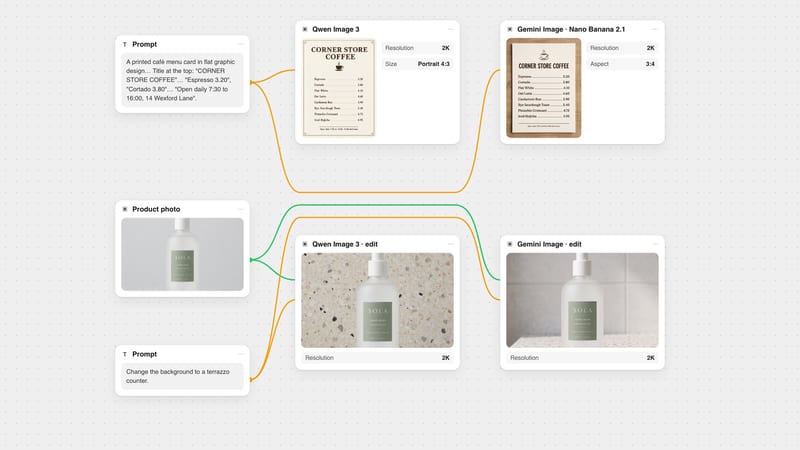
Write the prompt in the node, or wire in a prompt node so one brief can drive several models at once.
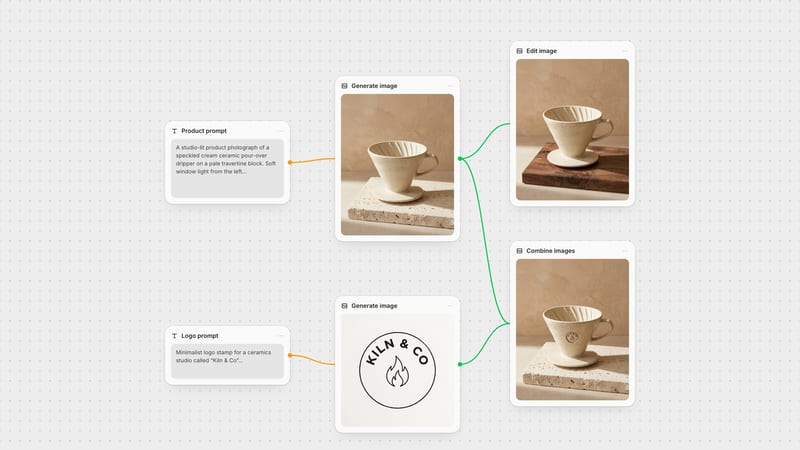
To edit, restyle or combine, connect up to 10 reference images from uploads or from other nodes' outputs.
Pick an aspect ratio (Auto, or 21:9 through 9:16) and a resolution: 1K for exploring, 2K (the default) for review, 4K for finals.
Turn on Search grounding when the image depicts a real product, landmark or recent event.
Run the node, then branch from the result: feed it into another Gemini Image node for the next edit, or into a video, upscale or 3D node.
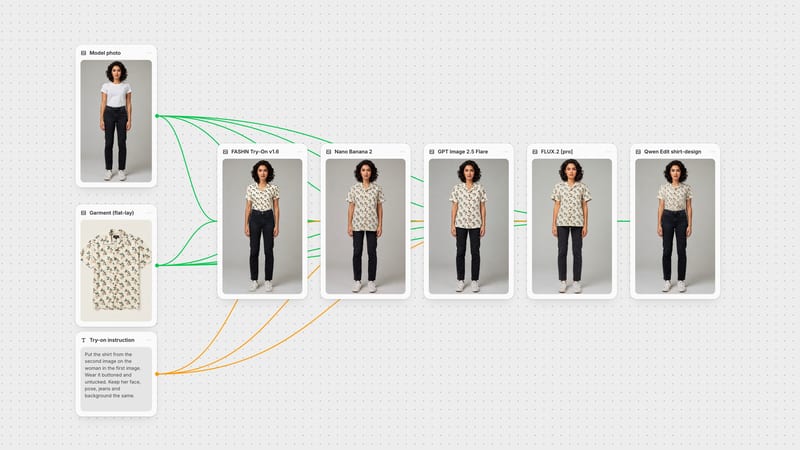
Because every step is a node, a multi-turn edit stays visible on the canvas: each version sits beside the last, so you can branch from any of them instead of starting a chat over.
Write a scene, not a tag list. Subject, then setting, then lighting and action, then style and medium. Comma-separated quality keywords ("masterpiece, 8k") add nothing.
Edit like a retoucher. Say what to change and what must stay: "Replace the marble counter with oiled walnut; keep the bottle, label and lighting unchanged."
Quote exact text. Put every word that should appear in the image inside quotation marks and say where it goes.
Give clean references. For a recurring character, use a few well-lit angles against plain backgrounds, and keep characters' wardrobes distinct so identities don't bleed.
Ground only real things. Search grounding helps with real products and places; leave it off for fantasy and abstract work.
The Nano Banana prompt guide walks through generate, edit and combine workflows step by step; every technique carries over to 2.1.
Google positions Nano Banana Pro as the premium model for the most complex visual work: the deepest world knowledge, advanced localization and precise brand consistency. Nano Banana 2.1 is the everyday workhorse: faster and cheaper, with the quality and text gains above. Both are options in the same Gemini Image node, so the practical test is simple: wire one prompt node into two Gemini Image nodes, set one to each model, and keep the better result. In our same-prompt test of Nano Banana 2.1, Nano Banana 2 and Pro, 2.1 followed the lighting brief best in the photo and product shots, while Pro made the closest likeness of a reference face.
Specs verified against Google's Gemini API documentation on 6 October 2026. For more same-prompt results, see Nano Banana 2 vs GPT Image 2.5.
From Google's Gemini API documentation, checked 6 October 2026.
| Feature | Nano Banana 2.1 | Nano Banana 2 |
|---|---|---|
| At a glance | ||
| Model ID | gemini-nano-banana-2.1 | gemini-3.1-flash-image |
| Status | Generally available since 6 October 2026 | Deprecated; shuts down 29 October 2026 |
| Image output price | Half of Nano Banana 2's rate | Twice Nano Banana 2.1's rate |
| Quality, text and consistency | Improved visual quality, prompt adherence, text rendering and multi-turn character consistency | Previous generation |
| Resolutions in Fuser | 1K, 2K, 4K | 1K, 2K, 4K |
| Search grounding in Fuser | Yes | Yes |
| Default in Fuser | Yes, for every new Gemini Image node | No; saved nodes keep it until switched |
Nano Banana 2.1 (gemini-nano-banana-2.1) is Google's high-efficiency Gemini image generation and editing model, released on 6 October 2026 as an update to Nano Banana 2. In Fuser it is the default model in the Gemini Image node.
Google reports improved visual quality, prompt adherence, text rendering and multi-turn character consistency, and prices its image output at half Nano Banana 2's rate. Google recommends it for all new projects.
Yes. Google deprecated gemini-3.1-flash-image (Nano Banana 2) on 6 October 2026 and will shut it down on 29 October 2026. In Fuser, switch any saved Gemini Image node that uses Nano Banana 2 to Nano Banana 2.1.
Add a Gemini Image node to a Fuser canvas. Nano Banana 2.1 is selected by default; write a prompt, optionally connect up to 10 reference images, choose aspect ratio and resolution, and run the node.
No. Nano Banana Pro (Gemini 3 Pro Image) is Google's premium image model for the most complex work. Nano Banana 2.1 is the faster, more efficient counterpart. Both are available in Fuser's Gemini Image node.
Google adds an invisible SynthID watermark to every image its Gemini image models generate, and Google Cloud lists C2PA content credentials support for Nano Banana 2.1.
Add a Gemini Image node and it's ready: generate, edit and chain into video on one canvas.