One click, whole workflow
Recipes are here. Package a whole workflow and run it in one click
Explore recipesOne click, whole workflow
Recipes are here. Package a whole workflow and run it in one click
Explore recipesWhat makes the Jean Phil AI character work, and how to make your own in Fuser: three original characters with 11-shot sheets and profiles, then dance clips with MiniMax H3 Recast.
All guides · Jean Phil–Inspired Character Sheets recipe
Quick answer: the fastest way to make a Jean Phil-style AI character is the Jean Phil–Inspired Character Sheets recipe in Fuser. Type one idea, or leave it on SURPRISE ME, and you get three original characters, each with an 11-shot character sheet and a profile with a name, handle, signature move, captions and post ideas. Then put your character in motion: MiniMax H3 Recast swaps them into any dance clip, from a moonwalk to the deadpan rap dance Jean Phil fans are copying.
Jean Phil, short for Jean Philanthrope, is an AI-generated French character that took over TikTok, Instagram and X in late September 2026. The look never changes: a blond bob, a curled mustache and a brown houndstooth suit. The act barely changes either: he shadowboxes, silently and with total seriousness, in places where nobody shadowboxes, from an oyster lunch to a café table with an espresso and a croissant (Know Your Meme).
His earliest known post is dated 17 September 2026, and as of 25 September the Instagram account had more than 228,000 followers (Dexerto). Fans then set him to "Gang Gang" by Chef Boy, and the dance edits became a trend of their own. Within days, copycat characters with their own accounts and storylines followed. His bio also links to a meme coin. This guide is about the character craft, not the token.
Jean Phil set off a run of copycat AI characters, each with its own account and storyline (Dexerto). Two are worth knowing:
Archibald Brown is the English answer to Jean Phil: a suited gentleman with a twirled mustache, written as his rival and out to fight him. The feud gives every post a storyline, and as of 25 September he had more than 110,000 followers.
Derek Mercer is a gym character with long hair and exaggerated muscles. He is far smaller, at around 1,200 followers as of the same date.
The gap between them is the lesson. Archibald borrowed the format and added a story that plays off the original; Derek borrowed the format alone. If you are building a character for this moment, give them a rival, a mission or a running bit, not just a look. That is the seventh part of the formula below.
Strip away the meme and Jean Phil is a tight character design in seven parts:
An ordinary identity. A job, an age and a city that sound real. The joke needs a straight man, and here the character is his own straight man.
One unmistakable silhouette. A haircut, a mustache, a suit. You should recognise him from a thumbnail at arm's length.
A wardrobe that never changes. Same outfit in every clip, so every post reads as the same person.
One signature physical act. Shadowboxing, for him. One move, repeated in new places, is easier to follow than a new bit every time.
Deadpan delivery. No winks at the camera. The seriousness is the punchline.
Bystanders who react. A stunned onlooker tells the viewer how absurd the moment is without a caption.
A running storyline or rival. Something that makes the next post worth waiting for: a feud, a mission, a slowly escalating bit. This is the part copycats skip, and it is what separated Archibald Brown from Derek Mercer.
The recipe is built around that formula. Each character comes with a job, a city and a look, a signature flex, a personality, and action shots that put the move in a real setting with people reacting in the background. The profile's back story and post concepts are where the storyline starts: pick the one with a rival or a mission and build the account around it.
Open the Jean Phil–Inspired Character Sheets recipe and sign in.
Replace SURPRISE ME in the Character Idea input with a short direction such as a person, a place, a sport or a tone. Leave it as it is to get three unexpected personas.
Run it. You get three characters, each with an image and a profile.
The character sheet is an 11-shot contact sheet: a six-view turnaround, a school-photo-style portrait, two close-ups and two action shots.
The character profile gives the name and handle, the physical description and wardrobe, the signature flex and moves, personality, back story, suggested captions and post concepts.
Pick the one you would follow. Keep its sheet on the canvas; it is the reference for every clip that comes next.
Here are three characters from two runs of the recipe. None of them is a real person.
The input works best as one line that pairs a dull identity with an unlikely skill. The recipe's own example is "grandma bodybuilder in Tokyo". A few more:
retired tax auditor who does parkour in multi-storey car parks
Lisbon tram conductor who breakdances at every stop
Swiss watch repairman who juggles anything within reach
hotel concierge in Marrakech who answers every question with a cartwheel
bank manager in Seoul who skateboards between meetings
If a result is close but not right, edit the input and run again, or keep the sheet and change only what you need.
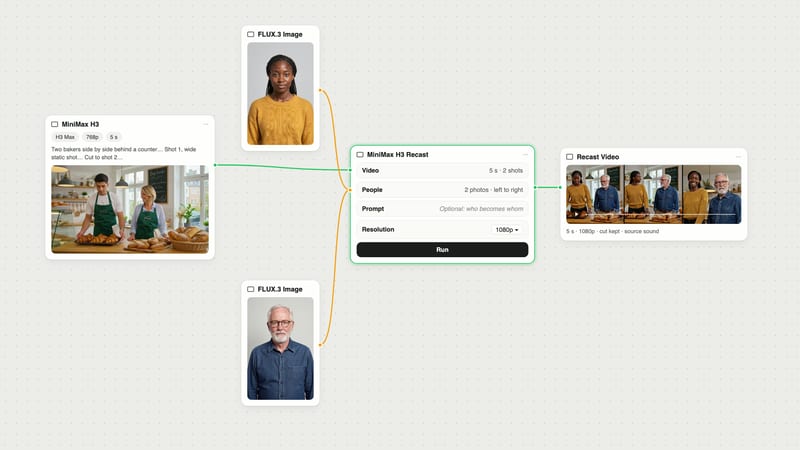
A character sheet is a reference; the trend lives in video. The quickest way to get a dance clip that looks like your character is to recast an existing one. MiniMax H3 Recast takes a 5 to 30 second video and one photo per person, then swaps the people while keeping the motion, the camera, the background and the sound.
We did exactly that with two characters from the recipe run. GPT Image 2.5 pulled a clean full-body photo of each character out of their sheet. Seedance 2.5 made two 8-second vertical source clips of anonymous dancers in matching locations: a rooftop for Renato, a library for Agnes. Recast then put the characters into those clips.
Four things we learned from the run:
Use a full-body reference, not the sheet. Recast takes one photo per person, and the clothes in that photo replace the ones in the video. A clean, front-facing photo carries the whole outfit into every frame.
Match the source to the character's world. Recast keeps the background, so generate or film the dance where your character would actually be.
Keep each continuous shot under 15 seconds. That limit applies per shot, before a cut; the whole clip can run 5 to 30 seconds.
Name the dancer when others are in shot. With no prompt, Recast replaces the leftmost main person. In the library clip the readers sit to her left, so we added one line: replace the woman in the blue dress who is dancing, and keep the readers as they are.
Want the real "Gang Gang" audio? Recast keeps whatever soundtrack the source clip has, so add licensed music on the platform you post to. For more on the node, read the MiniMax H3 Recast guide.
The sheet is the source of truth. For new stills, edit from the turnaround rather than describing the character again from scratch. For new clips, animate from an approved frame with Kling 3.0 or Seedance 2.5, or recast a new dance. The full method is in how to keep AI characters consistent.
The characters that grew out of the Jean Phil wave got attention because they were new people with their own look and their own bit, not because they copied his suit. An original character is also something you can own. Use the recipe to invent someone, never to clone an existing creator's persona, and never base a character on a real person without their consent. Disclose AI-generated people where the platform asks you to.
Every step above runs as nodes on one canvas, so the character idea, the sheet, the reference photo and the dance clips stay connected. Save the graph as a Recipe and your next character starts from the same pipeline. Open the recipe to make your first three.
Jean Phil (Jean Philanthrope) is an AI-generated French character with a blond bob, a curled mustache and a brown houndstooth suit who went viral on TikTok, Instagram and X in September 2026 by silently shadowboxing in absurd places.
Coverage of the trend, including Dexerto and Know Your Meme, describes Jean Phil as an AI-generated persona rather than a real person.
Give the character an ordinary job and city, one unmistakable look, a fixed outfit and one signature move performed deadpan. In Fuser, the Jean Phil–Inspired Character Sheets recipe turns one line of direction into three characters with 11-shot sheets and ready-to-post profiles.
Take a short clip of someone doing the dance, or generate one, and run it through MiniMax H3 Recast in Fuser with a full-body photo of your character. Recast swaps the person and keeps the moves, camera and sound.
Most of the dance edits use "Gang Gang" by Chef Boy. Add licensed music on the platform you post to rather than baking it into the video.
They are AI-generated characters that followed Jean Phil. Archibald Brown is an English gentleman written as Jean Phil's rival; Derek Mercer is a long-haired bodybuilder character. Both run their own accounts in the same deadpan, single-gag format.
Make your own character instead. Copying an existing creator's persona is imitation, and an original character is something you can build an account around and own.
Type one idea, get three characters with sheets, profiles and captions.