One click, whole workflow
Recipes are here. Package a whole workflow and run it in one click
Explore recipesOne click, whole workflow
Recipes are here. Package a whole workflow and run it in one click
Explore recipesTwo prompts, three video models, matched settings: what Seedance 2.5, Kling 3.0 Pro and Veo 3.1 actually produced for a product camera move and a spoken line, and when to reach for each.
All guides · Best image-to-video models
Quick answer: in our same-prompt test, Veo 3.1 was the one to pick for a person speaking on camera: one continuous shot, face in frame, line delivered cleanly. Kling 3.0 Pro and Seedance 2.5 both delivered the camera move on a product shot, and Seedance 2.5 kept the speaking scene as a single take. Kling 3.0 added a cut to the dialogue scene that we didn't ask for. This is a small test, two prompts and one run per model, so treat it as a guide to each model's tendencies, not a ranking.
We ran two prompts through each model on 28 September 2026, one generation each, with no retries or cherry-picking:
Models: Veo 3.1 (standard, not Fast), Kling 3.0 Pro text-to-video and Seedance 2.5 text-to-video: the versions available in Fuser.
Matched settings: 6 seconds, 16:9, audio on. Veo 3.1 and Seedance 2.5 were set to 720p; Kling 3.0 has no resolution setting and returned 1080p.
Test 1, product move: "Slow dolly-in on a matte terracotta vase standing on a travertine plinth in a sunlit plaster room. Late-afternoon light slides slowly across the wall as dust drifts through the beam. Calm, premium product film, shallow depth of field. Audio: soft room tone and a faint breeze."
Test 2, person and dialogue: "Handheld medium shot of a ceramicist at a pottery wheel shaping a tall vase from wet clay, her hands glistening as the clay spins. She glances up at the camera, smiles and says: 'Almost there.' Warm workshop light. Audio: steady wheel hum, wet clay sounds, quiet studio ambience."
We checked the frames by eye, detected cuts from frame changes and transcribed each clip's audio to confirm what was said and when.
Veo 3.1 produced the most atmospheric frame: a strong window-light pattern and visible dust in the beam. The camera barely moved, so the requested dolly-in is hard to see, and the plinth came out as a thin shelf.
Kling 3.0 Pro delivered a clear slow push-in and the travertine block plinth as written, with a raking patch of sunlight on the wall. The dust was not visible, and the ambient audio was close to silent.
Seedance 2.5 gave the steadiest, most obvious push-in, with shadows drifting across a warm wall and an audible room tone.
For product film with a specific camera move, Kling 3.0 and Seedance 2.5 followed the direction more literally than Veo 3.1 in this run.
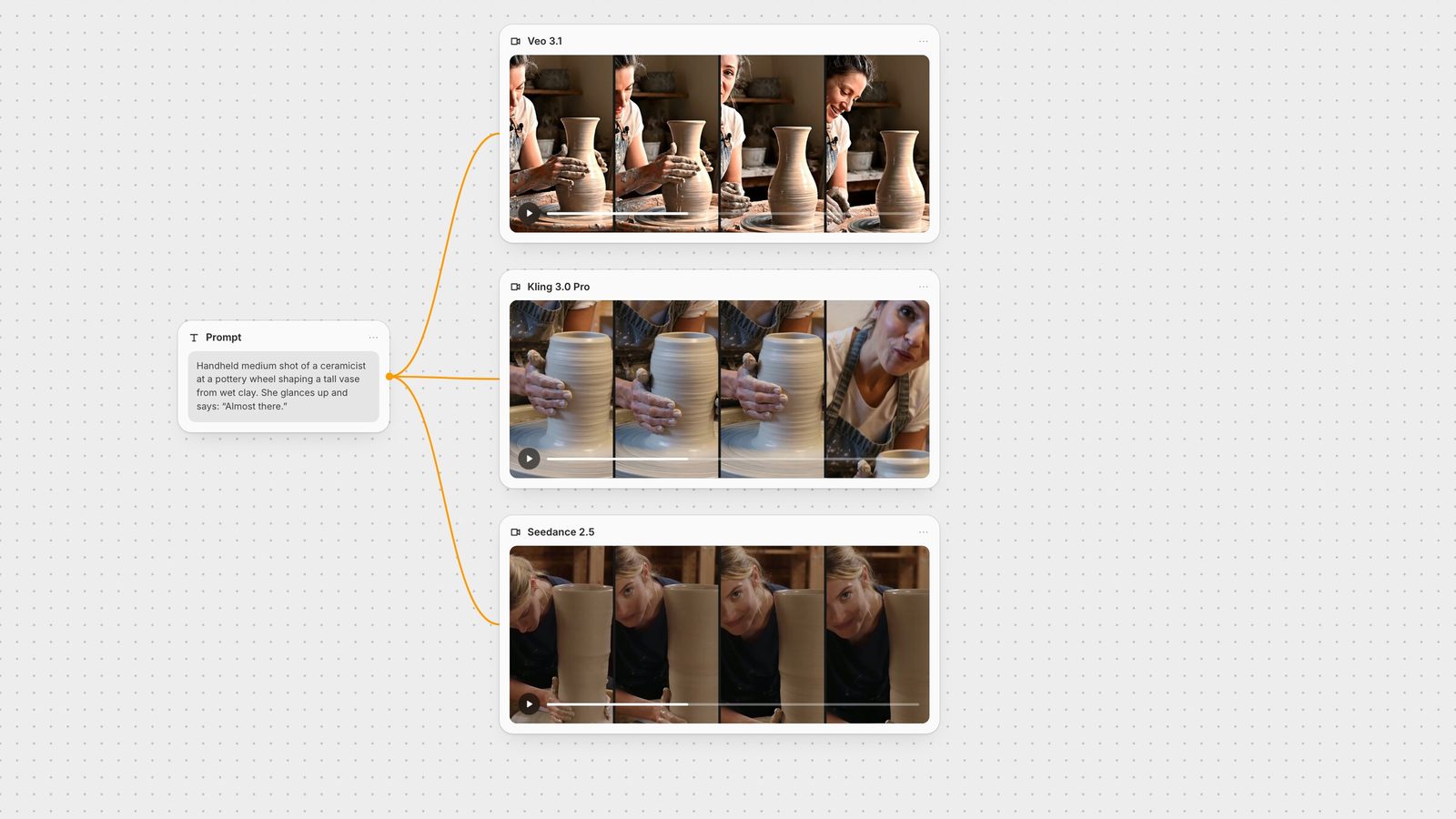
Veo 3.1 held one continuous shot with the potter's face and hands in frame throughout. She looks up and says "Almost there" at about three seconds, and the mix, with wheel hum and clay sounds, was the fullest of the three.
Kling 3.0 Pro framed the first four and a half seconds from the chest down, so the face was out of frame, then cut to a wider shot where she speaks at about five seconds. The vase's shape changed across the cut. Kling 3.0 plans shots on its own; for a single take, say "one continuous shot" in the prompt (Kling 3.0 prompt guide).
Seedance 2.5 held a single take and delivered the line at about four and a half seconds, looking into camera. The hands were mostly hidden behind the vase and the light was cooler than "warm workshop".
For a speaking character, Veo 3.1 was the most reliable here. See the Veo 3.1 prompt guide for how to write dialogue.
Veo 3.1: 4, 6 or 8 second clips at 720p or 1080p; first frame, first-and-last frame, or up to three reference images of a single subject (Gemini API: Veo).
Kling 3.0: 3 to 15 seconds, Standard or Pro tier, start and end frames, native audio with tagged multi-character dialogue in five languages, and automatic multi-shot planning (Kling VIDEO 3.0 guide).
Seedance 2.5: up to 30 seconds in a single generation and up to 30 reference images, 10 video clips and 10 audio clips in one pass (ByteDance Seed). In Fuser, the Seedance node takes 4 to 30 seconds and aspect ratios from 21:9 to 9:16.
The fastest way to choose is to test your own brief. In Fuser, put the prompt in one text node and connect it to the Veo, Kling 3.0 Video and Seedance nodes side by side. Add a start frame from an image model when the look has to match your brand, then send the chosen clip to an upscaler or Auto Caption without leaving the canvas.
Based on two prompts, one run per model, 28 September 2026.
| Model | In our test | Reach for it when |
|---|---|---|
| Shortlist | ||
| Veo 3.1 | Best speaking scene: one take, face in frame, clean line. Camera move on the product was minimal. | A character speaks on camera, or you need 1080p with a first and last frame. |
| Kling 3.0 Pro | Clear push-in and accurate plinth on the product. Added a cut to the dialogue scene. | You want a directed camera move, start and end frames, or planned multi-shot sequences. |
| Seedance 2.5 | Steadiest push-in; single-take dialogue with the line delivered to camera. | You need longer takes (up to 30 seconds) or many image, video and audio references. |
It depends on the shot. In our test Veo 3.1 handled a speaking character best, while Kling 3.0 Pro followed a product camera move more literally. Run your own brief through both before committing.
They overlapped in our product test: both delivered the push-in. Seedance 2.5 kept the dialogue scene as one take, and it supports much longer clips (up to 30 seconds) and more references per generation.
In our same-prompt test, Veo 3.1 kept the speaker on screen and delivered the line cleanly in one shot. Kling 3.0 and Seedance 2.5 also spoke the line, with Kling adding a cut.
Veo 3.1 generates 4, 6 or 8 seconds, Kling 3.0 generates 3 to 15 seconds, and Seedance 2.5 generates up to 30 seconds in a single pass.
Yes. In Fuser you can connect one prompt node to several video model nodes on the same canvas and compare the results before choosing one for the final edit.
One prompt, three video nodes, one canvas: pick the take that fits.