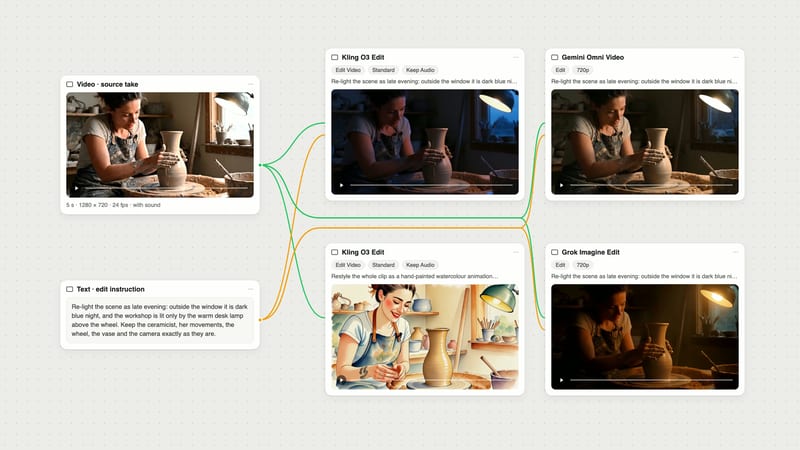
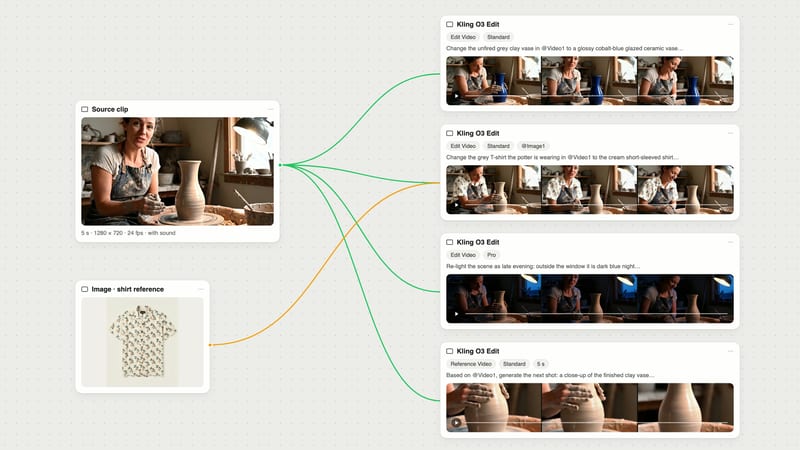
One click, whole workflow
Recipes are here. Package a whole workflow and run it in one click
Explore recipesOne click, whole workflow
Recipes are here. Package a whole workflow and run it in one click
Explore recipesbyLightricks
Direct cinematic motion with natively synchronized audio, from fast storyboard drafts to precise retakes of an existing clip
Write a scene the way a director would brief it, pick a tier, and get a clip that already sounds finished. Retakes let you fix one moment instead of starting over.
Frame the scene
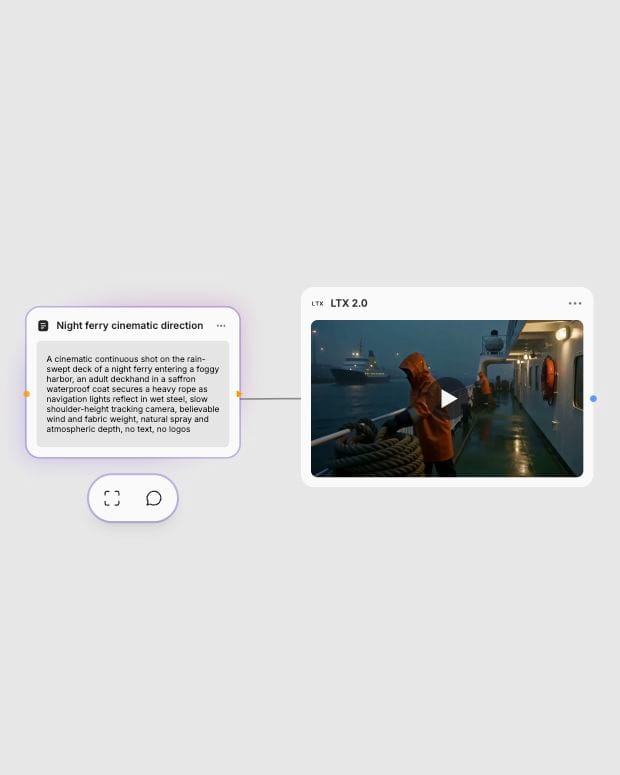
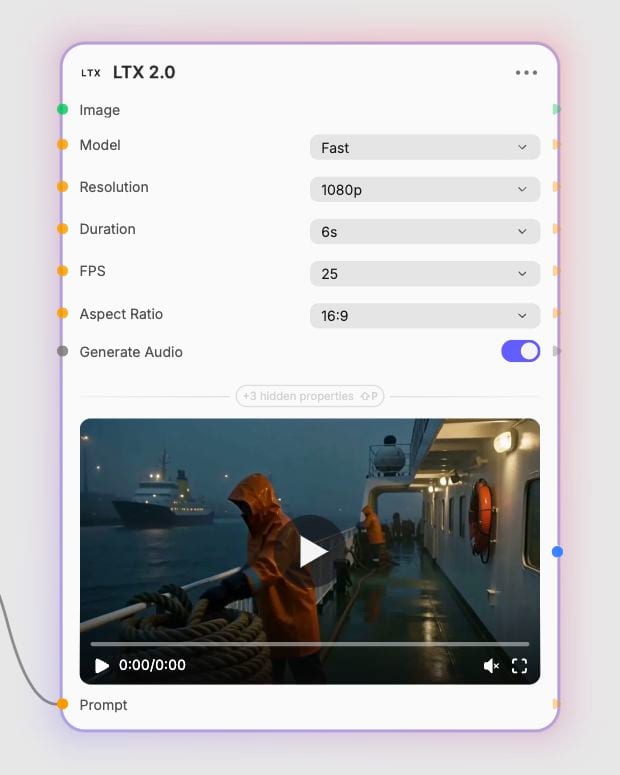
Write one present-tense paragraph with framing, light, action and sound, or drop in a still as the first frame.
Pick Fast or Pro
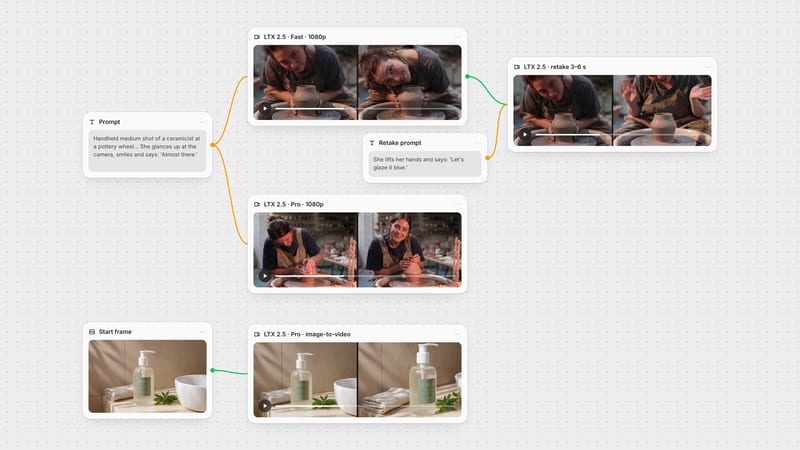
Choose Fast for quick iteration, longer clips and up to 4K output, or Pro for quality-optimized final shots at up to 1080p.
Turn on sound, then retake
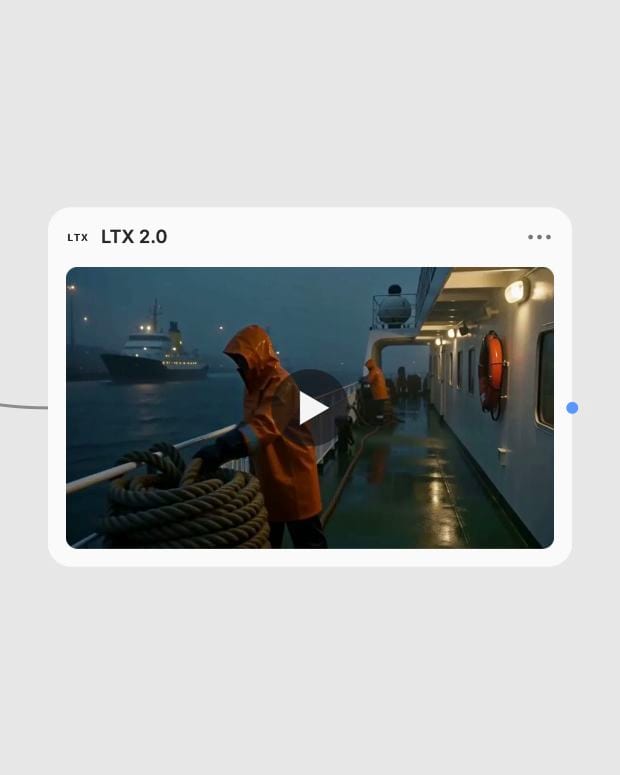
Generate synchronized sound alongside the picture, or connect an existing video to retake a time window, replacing its picture, its audio, or both.
Lightricks' open-source audio-video model generates picture and sound together in a single pass, from a text prompt or a still image.
A gallery of clips where the sound carries as much as the image: copper footsteps in a limestone hall, glass hissing at the furnace, a synth trace pulsing on beat.
Architectural tension in bleached limestone and copper
Sensory craft documentation with synchronized tactile Foley
High-contrast analog synthesis visualizer
Macro material collision in razor-sharp clarity

A spoken line with room tone, straight from a prompt
Filmmakers, ad teams, product designers and musicians reach for it when a clip needs voice and sound design from the first frame, not a separate audio pass later.
LTX 2.5 is the newer release of Lightricks' open-source LTX-2 audio-video model family. Fuser's LTX node now runs LTX 2.5 for text-to-video and image-to-video, and uses LTX-2.3 for retakes, which LTX 2.5 does not offer.
Fast mode is built for speed and range: it renders at 720p up to 4K and supports clips up to 20 seconds at 720p or 1080p and 25 FPS; higher resolutions and 50 FPS are limited to 10 seconds. Pro mode is quality-optimized, renders at 720p or 1080p, and supports clips up to 10 seconds.
Yes. Connect the video, choose a retake mode and a start time, and replace the audio, the picture, or both. Replace Audio rewrites dialogue or redesigns Foley without touching the visuals; Replace Video reshoots the action while keeping the original audio timing. It runs on an earlier engine iteration, and big structural changes can leave transition seams.
Yes. With audio enabled, LTX 2.5 generates synchronized ambience, Foley and sound effects in the same pass as the video, matched to the motion on screen.
Like other video models, LTX 2.5 is less reliable with legible on-screen text, flat 2D graphic animation and very fast action with rapid cuts. It is strongest on physically grounded, cinematic shots with deliberate camera movement.
It struggles with overlapping multi-character dialogue, dense typography and extreme high-speed acrobatics. Long conversations with rapid speaker switches, text that must hold exact layout in every frame and vector-style graphics are better handled elsewhere. Hands can deform during fast gestures, and long pans away from the start frame may soften or drift.
Direct cinematic motion with natively synchronized audio, from fast storyboard drafts to precise retakes of an existing clip