One click, whole workflow
Recipes are here. Package a whole workflow and run it in one click
Explore recipesOne click, whole workflow
Recipes are here. Package a whole workflow and run it in one click
Explore recipesbyGoogle DeepMind
Full-length studio musical arrangements and expressive vocal performances guided by structural timestamps and visual inspiration
Direct tempo, structural timestamps, and visual moodboards to generate complete stereo arrangements in three focused actions.
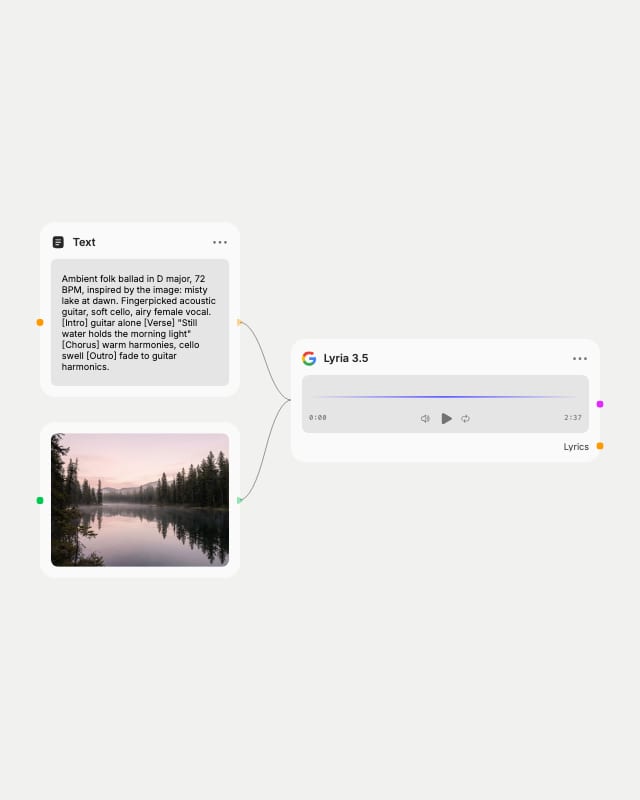
Define Structure and Style
Set the key, tempo in BPM, and section markers like [Intro], [Verse], and [Chorus] alongside any desired lyrics.
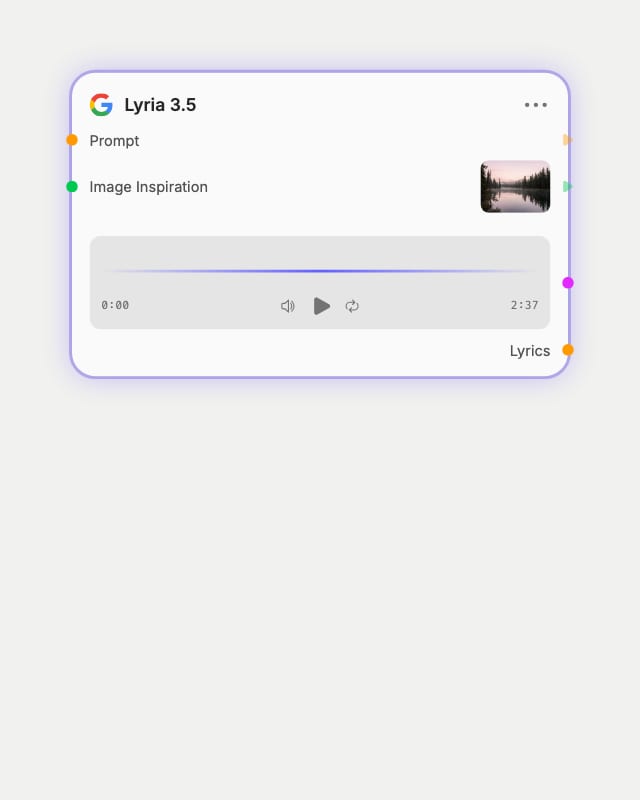
Attach Visual Inspiration
Provide a concept still or moodboard to align the harmonic texture and emotional palette with visual aesthetics.
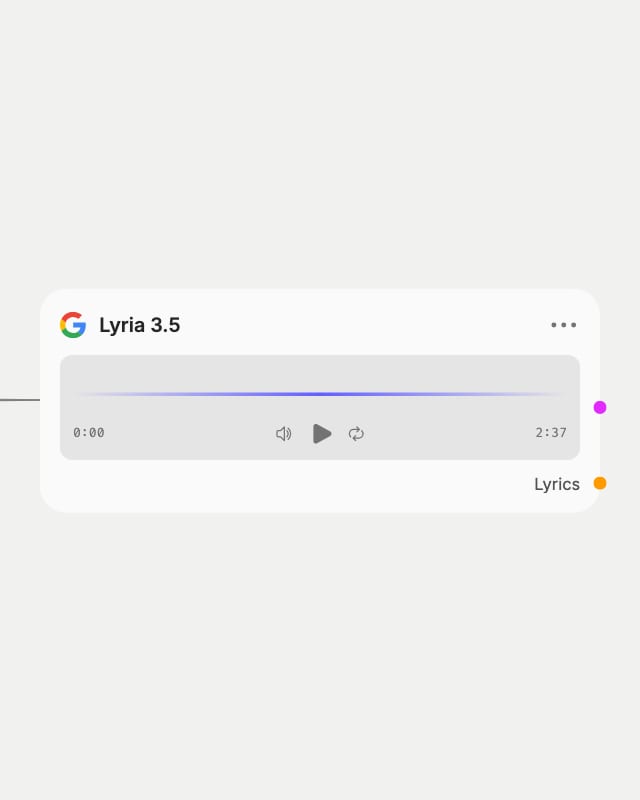
Generate Full Master and Lyrics
Produce a cohesive stereo arrangement up to three minutes long alongside synchronized lyrics text.
From long-form architectural planning to image-guided scoring, discover what sets this music generation model apart.
Explore full-length musical arrangements spanning cinematic scores, dance grooves, and vocal ballads generated from text and image prompts.
See how music producers, filmmakers, brand directors, and game developers build soundtrack-ready audio with Lyria 3.5.
Lyria 3.5 is engineered for full-length structured songs up to 3 minutes, complete with multi-section arrangements (intro, verse, chorus, bridge, outro), realistic vocal singing, and multi-modal image conditioning. It plans harmonic progressions and melodic motifs across the entire piece rather than repeating short loops.
Use timestamp markers and bracketed structural tags in your prompt, such as [00:00 - 00:20] [Intro] and [00:20 - 00:50] [Verse]. To enforce specific singing, prefix lines with Lyrics: inside the section blocks, and define the key signature and BPM upfront to anchor the groove.
Lyria 3.5 generates a unified, mixed stereo audio file (and transcribed lyrics) rather than isolated multitrack stems (such as separate drum, bass, or vocal tracks). It is also not suited for non-musical Foley sound effects or sub-millisecond audio editing.
Lyria 3.5 was developed by Google DeepMind. The architecture was initially introduced in November 2023, bringing long-form harmonic planning and SynthID imperceptible audio watermarking to generative music synthesis.
Full-length studio musical arrangements and expressive vocal performances guided by structural timestamps and visual inspiration